
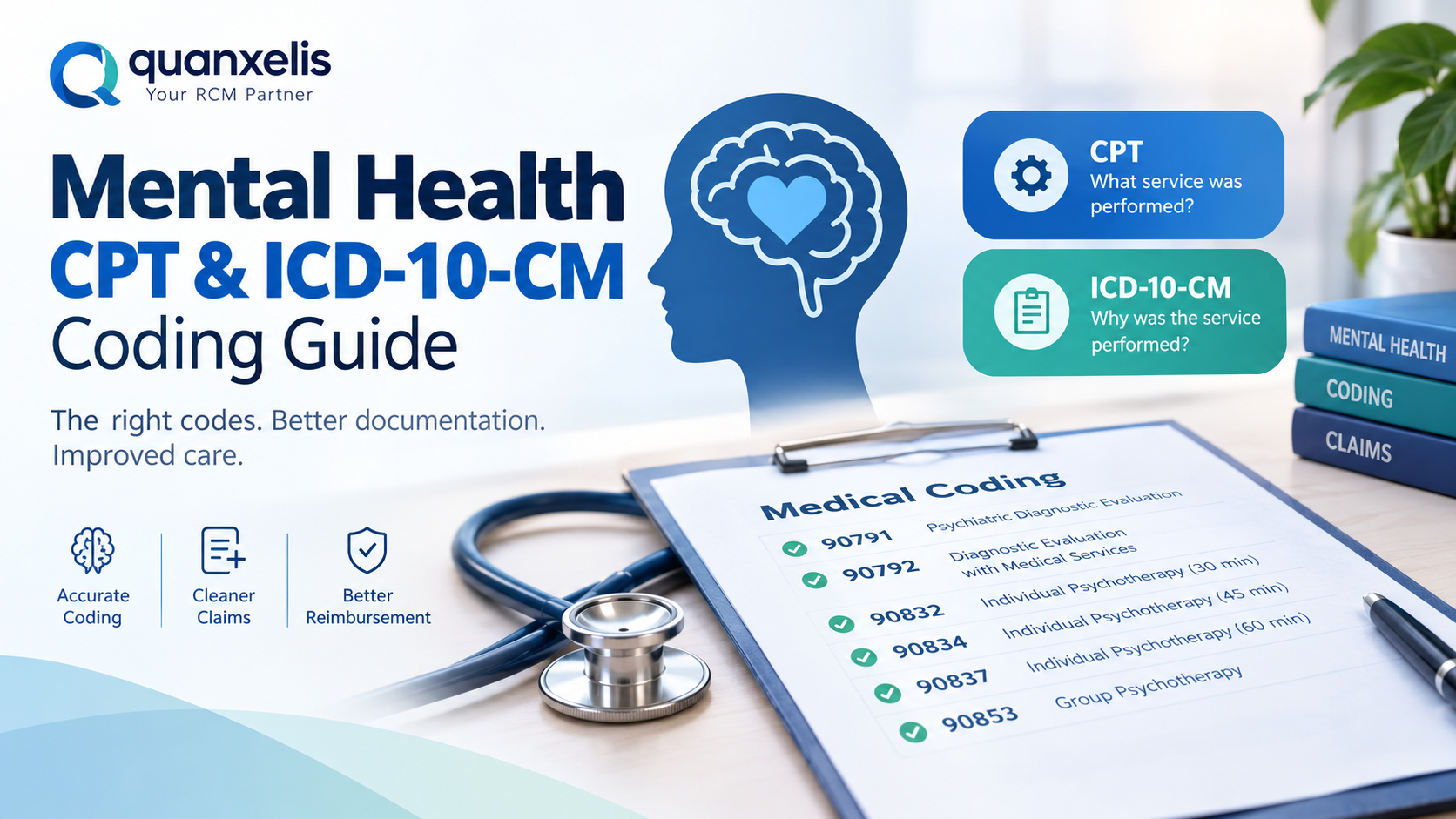

Accurate medical coding is an essential part of operating a mental health clinic. Proper coding helps providers communicate the services delivered, document the patient’s condition, support claims submission, and reduce avoidable billing errors.
Mental health services can include psychiatric evaluations, individual psychotherapy, family therapy, group therapy, crisis services, behavioral assessments, and other behavioral health interventions.
Each service requires appropriate CPT/HCPCS procedure coding, while the patient’s documented diagnosis or reason for the encounter is represented using ICD-10-CM diagnosis codes.
This guide explains the most commonly encountered mental health CPT codes, common ICD-10-CM diagnosis categories, documentation considerations, and common coding mistakes.
1. What Is Mental Health Medical Coding?
Mental health medical coding is the process of translating behavioral and mental health services into standardized medical codes used for billing, documentation, claims processing, and reporting.
Two major coding systems are commonly involved:
- CPT — describes the service or procedure performed.
- ICD-10-CM — describes the patient’s diagnosis, condition, symptom, or reason for the encounter.
In simple terms:
CPT = What service was performed?
ICD-10-CM = Why was the service performed?
Both need to be supported by the medical record.
2. Why Accurate Mental Health Coding Matters
Incorrect coding can create problems for both providers and patients.
Accurate coding helps a mental health clinic:
- Submit cleaner claims
- Support medical necessity
- Reduce claim denials
- Maintain accurate patient records
- Communicate services consistently with payers
- Support appropriate reimbursement
- Reduce coding and documentation discrepancies
- Maintain compliance with payer requirements
CMS emphasizes that using the appropriate CPT/HCPCS codes is essential when reporting mental health services.
3. CPT Codes vs. ICD-10-CM Codes
Understanding the difference between procedure and diagnosis coding is fundamental.
CPT Codes
CPT codes describe the service performed by the provider.
Examples include:
- Psychiatric diagnostic evaluation
- Individual psychotherapy
- Family psychotherapy
- Group psychotherapy
- Crisis psychotherapy
- Interactive complexity
ICD-10-CM Codes
ICD-10-CM codes describe the patient’s documented diagnosis or reason for the encounter.
Examples may include:
- Depressive disorders
- Anxiety disorders
- Trauma- and stressor-related disorders
- Bipolar disorders
- Schizophrenia spectrum disorders
- Substance use disorders
- Other mental and behavioral conditions
The diagnosis should be supported by the provider’s documentation and coded to the appropriate level of specificity.
4. Common Mental Health CPT Codes
Mental health clinics may use a variety of CPT codes depending on the services provided.
90791 — Psychiatric Diagnostic Evaluation
90791 is used for a psychiatric diagnostic evaluation without medical services.
A comprehensive evaluation may include relevant history, mental status examination, assessment, diagnostic formulation, and treatment planning as appropriate to the service.
90792 — Psychiatric Diagnostic Evaluation With Medical Services
90792 is used for a psychiatric diagnostic evaluation that includes medical services.
This code is generally associated with providers who are qualified to perform the medical component of the service.
The documentation should support the evaluation and medical services provided.
5. Individual Psychotherapy CPT Codes
Individual psychotherapy is one of the most frequently billed services in behavioral health.
90832 — Psychotherapy, Approximately 30 Minutes
Used for qualifying individual psychotherapy services of approximately 30 minutes.
90834 — Psychotherapy, Approximately 45 Minutes
Used for qualifying individual psychotherapy services of approximately 45 minutes.
90837 — Psychotherapy, Approximately 60 Minutes
Used for qualifying individual psychotherapy services of approximately 60 minutes.
CMS identifies 90832, 90834, and 90837 as psychotherapy codes without medical management.
These are time-based services, so the medical record should support the amount of psychotherapy provided. CMS billing guidance specifically addresses documentation of total time or start/stop times for these services.
6. Psychotherapy With Evaluation and Management Services
When psychotherapy is performed with a qualifying evaluation and management service, the appropriate psychotherapy add-on codes may include:
- 90833
- 90836
- 90838
These are add-on codes and are used in conjunction with the appropriate E/M service when the applicable requirements are met.
They should not be treated as standalone replacements for 90832, 90834, or 90837.
7. Group Psychotherapy
90853 — Group Psychotherapy
90853 is used for qualifying group psychotherapy.
Group psychotherapy is different from individual psychotherapy because the service is delivered in a group setting.
Documentation should support:
- The group service
- Participants
- Clinical purpose
- Intervention provided
- Patient participation
- Relevant response/progress
8. Family Psychotherapy CPT Codes
Family involvement can be an important part of behavioral health treatment.
90846 — Family Psychotherapy Without the Patient Present
This code is used when qualifying family psychotherapy is provided without the patient present.
90847 — Family Psychotherapy With the Patient Present
This code is used for qualifying family psychotherapy involving the patient.
The service must meet the applicable CPT and payer requirements.
9. Psychiatric Crisis Services
Mental health clinics may also provide psychotherapy for patients experiencing a psychiatric crisis.
90839 — Psychotherapy for Crisis
90839 is used for qualifying psychotherapy for crisis for the initial period.
90840 — Additional Crisis Time
90840 is an add-on code used for additional time when the requirements are met.
CMS currently identifies 90839 as psychotherapy for crisis for the first 60 minutes and 90840 for each additional 30 minutes.
Crisis psychotherapy should not be billed simply because a patient is experiencing ordinary stress or an emotionally difficult situation. The documentation must support the nature of the crisis service.
10. Interactive Complexity — CPT 90785
90785 — Interactive Complexity
90785 is an add-on code that may be used when specific circumstances make the delivery of a psychiatric service substantially more complex.
CMS identifies situations involving communication difficulties, caregiver participation, third-party involvement, or other qualifying circumstances as examples of situations in which interactive complexity may apply.
It is not an automatic add-on for every difficult or emotionally complex patient encounter.
11. Behavioral Health Assessment and Intervention
Mental health and behavioral health practices may also provide services involving behavioral assessment and intervention.
Depending on the actual service, provider qualifications, and payer requirements, applicable CPT code families can include:
- 96156 — Health behavior assessment/intervention
- 96158 — Individual health behavior intervention
- 96159 — Additional time for qualifying health behavior intervention
- 96164/96165 — Group health behavior intervention
- 96167/96168 — Family health behavior intervention
- 96170/96171 — Family intervention in qualifying circumstances
These codes should not automatically be substituted for psychotherapy codes. The actual service must satisfy the CPT definition and applicable payer requirements.
12. Behavioral Health Screening
96127 — Brief Emotional/Behavioral Assessment
96127 may be used for certain standardized emotional or behavioral assessment instruments when the applicable requirements are met.
Examples of screening areas may include:
- Depression
- Anxiety
- Behavioral concerns
- Other emotional or behavioral conditions
The medical record should support the assessment performed and its purpose.
13. Common ICD-10-CM Categories Used in Mental Health
ICD-10-CM contains numerous diagnosis codes relevant to behavioral health.
The correct code depends on the provider’s documented diagnosis.
Common categories include:
F01–F09
Mental disorders due to known physiological conditions.
F10–F19
Mental and behavioral disorders due to psychoactive substance use.
F20–F29
Schizophrenia, schizotypal, delusional, and other psychotic disorders.
F30–F39
Mood disorders.
F40–F48
Anxiety, dissociative, stress-related, and other nonpsychotic mental disorders.
F50–F59
Behavioral syndromes associated with physiological disturbances and physical factors.
F60–F69
Disorders of adult personality and behavior.
F70–F79
Intellectual disabilities.
F80–F89
Pervasive and specific developmental disorders.
F90–F98
Behavioral and emotional disorders with onset usually occurring in childhood and adolescence.
F99
Unspecified mental disorder.
These categories are broad. The final diagnosis should be coded to the appropriate level of specificity based on the provider’s documentation.
14. Common Anxiety-Related ICD-10-CM Codes
Examples include:
F41.0 — Panic Disorder [Episodic Paroxysmal Anxiety]
Used when the documented diagnosis meets the criteria for panic disorder.
F41.1 — Generalized Anxiety Disorder
Used when generalized anxiety disorder is documented.
F41.9 — Anxiety Disorder, Unspecified
Used when an anxiety disorder is documented but the specific type is not established.
Anxiety symptoms alone do not automatically justify an anxiety disorder diagnosis.
15. Common Depressive Disorder Codes
Examples include:
F32.A — Depression, Unspecified
Used when depression is documented without greater diagnostic specificity.
F32.0 — Major Depressive Disorder, Single Episode, Mild
Used when the documented diagnosis supports this specific condition and severity.
F32.1 — Major Depressive Disorder, Single Episode, Moderate
Used when the documented diagnosis supports moderate severity.
F33.0 — Major Depressive Disorder, Recurrent, Mild
Used when recurrent major depressive disorder with the specified severity is documented.
The provider’s documentation should support the diagnosis and required level of specificity.
16. Trauma- and Stressor-Related Disorders
Mental health clinics may treat patients with trauma- and stressor-related conditions.
Potential ICD-10-CM categories include:
- F43.0 — Acute stress reaction
- F43.1 — Post-traumatic stress disorder
- F43.2 — Adjustment disorders
- F43.9 — Reaction to severe stress, unspecified
The specific diagnosis should be selected according to the provider’s documentation and the applicable ICD-10-CM classification.
17. Bipolar and Related Disorders
Bipolar disorders fall within the F30–F39 range.
Examples include:
- Bipolar I disorder
- Bipolar II disorder
- Current or most recent episode classifications
- Severity and remission distinctions where applicable
Mental health coding should capture the highest level of specificity supported by the clinical documentation.
18. Substance Use Disorder Coding
Substance-related conditions are represented primarily within the F10–F19 categories.
The specific code depends on:
- Substance involved
- Use pattern
- Abuse/dependence classification where applicable
- Current status
- Remission status
- Complications
The FY 2026 ICD-10-CM guidelines contain specific rules for coding substance-use disorders and remission status.
19. Z Codes in Mental Health
Not every behavioral health encounter is necessarily represented by an F-code.
Certain circumstances may be represented by Z codes, depending on the purpose and documentation of the encounter.
Examples can include:
- Counseling
- Social circumstances
- Personal history
- Family history
- Other factors affecting health status
For example, ICD-10-CM includes Z81 for family history of mental and behavioral disorders and Z91.4- for personal history of psychological trauma not elsewhere classified.
The reason for the encounter should be appropriately sequenced according to the ICD-10-CM Official Guidelines.
20. How to Choose the Correct CPT Code
A mental health biller should not select a CPT code simply by looking at the patient’s diagnosis.
Instead, ask:
Step 1: What service was provided?
Was it:
- Diagnostic evaluation?
- Individual psychotherapy?
- Group psychotherapy?
- Family psychotherapy?
- Crisis psychotherapy?
- Behavioral assessment?
- Health behavior intervention?
Step 2: How long was the service?
For time-based services, verify that the documented time supports the selected code.
Step 3: Who provided the service?
Confirm the provider’s:
- License
- Credentials
- Scope of practice
- Payer enrollment
- Applicable billing requirements
Step 4: Was the service clinically appropriate?
The medical record should establish the purpose and nature of the service.
Step 5: Does the payer cover the service?
Payer policies can differ.
21. How to Choose the Correct ICD-10-CM Code
The diagnosis code should come from the provider’s documentation.
Consider:
- What condition is being treated?
- What symptoms are documented?
- What diagnosis was established?
- Is greater specificity available?
- Is severity documented?
- Is the condition current or in remission?
- Does the selected code accurately represent the clinical record?
The goal is to report the diagnosis at the highest level of specificity supported by the documentation, rather than choosing a broad diagnosis when a more specific documented diagnosis exists.
22. CPT and ICD-10-CM Coding Examples
Example 1: Individual Psychotherapy
A patient receives an individual psychotherapy session addressing a documented anxiety disorder.
CPT: Appropriate psychotherapy code based on the documented service and time.
ICD-10-CM: An appropriate anxiety diagnosis supported by the clinical record.
The diagnosis does not determine whether the session was 90832, 90834, or 90837. The service and documented time determine the applicable psychotherapy CPT code.
Example 2: Initial Psychiatric Evaluation
A patient presents to a psychiatrist for an initial comprehensive psychiatric evaluation.
CPT: 90791 or 90792, depending on the service performed and whether medical services are included.
ICD-10-CM: The diagnosis or documented clinical condition established through the evaluation.
Example 3: Group Psychotherapy
A mental health clinic provides qualifying group psychotherapy for several patients with documented behavioral health conditions.
CPT: 90853
ICD-10-CM: Each patient’s diagnosis should reflect that patient’s documented condition.
Example 4: Family Psychotherapy
A clinician provides qualifying family psychotherapy involving the patient and family members.
CPT: 90847 when the requirements are met.
ICD-10-CM: The patient’s documented condition or reason for treatment.
Example 5: Psychiatric Crisis
A patient presents with a qualifying psychiatric crisis requiring crisis psychotherapy.
CPT: 90839, with 90840 when additional qualifying time is provided.
ICD-10-CM: The documented condition responsible for the crisis.
CMS specifically distinguishes crisis psychotherapy from ordinary psychotherapy and diagnostic services.
23. Documentation Requirements for Mental Health Billing
Strong documentation is one of the most important parts of clean behavioral health billing.
A record should generally contain information appropriate to the service, such as:
Patient Information
- Patient name
- Date of birth
- Date of service
- Provider information
Reason for Encounter
- Chief concern
- Presenting symptoms
- Relevant history
Clinical Assessment
- Mental status findings when appropriate
- Assessment
- Diagnosis
- Relevant risk assessment
Treatment or Intervention
- Type of service
- Therapeutic intervention
- Patient response
- Progress toward treatment goals
Time
For time-based CPT services, document the applicable time requirements.
Treatment Plan
- Goals
- Follow-up
- Continued treatment
- Referrals when appropriate
Documentation requirements can vary according to the service, payer, and setting.
24. Common Mental Health Coding Mistakes
Using the Wrong Psychotherapy Code
Choosing 90837 simply because a session was described as “therapy” is not enough. The documentation must support the service and applicable time requirements.
Coding a Diagnosis That Was Not Documented
A biller should not independently diagnose a patient.
Using an Unspecified Code When Specific Information Is Available
When the provider documents a more specific diagnosis, the claim should generally reflect the appropriate level of specificity.
Billing Coaching as Psychotherapy
A coaching or wellness session is not automatically psychotherapy.
The actual service must meet the applicable CPT definition and provider requirements.
Adding 90785 to Every Difficult Session
Interactive complexity has specific requirements. It is not an automatic add-on for a challenging patient encounter.
Ignoring Time Documentation
Time-based psychotherapy services require documentation that supports the reported service.
Ignoring Payer-Specific Requirements
Medicare, Medicaid, commercial insurers, and other payers may have different coverage and billing requirements.
25. Mental Health Billing and Denials
Coding errors can contribute to claim denials.
Common problems may include:
- Incorrect CPT code
- Incorrect ICD-10-CM code
- Diagnosis not supporting the billed service
- Missing documentation
- Incorrect provider credentials
- Missing authorization
- Incorrect modifier
- Incorrect place of service
- Eligibility issues
- Payer-specific billing requirements
- Insufficient medical necessity documentation
A strong revenue cycle process should identify these issues before claims are submitted whenever possible.
26. CPT and ICD-10-CM Coding Workflow
A simple workflow for a mental health clinic is:
Patient Registration
↓
Eligibility Verification
↓
Provider Documentation
↓
Diagnosis Review
↓
CPT Selection
↓
ICD-10-CM Selection
↓
Claim Scrubbing
↓
Claim Submission
↓
Payer Adjudication
↓
Payment Posting
↓
Denial Management
↓
A/R Follow-Up
This connects coding directly with the broader mental health revenue cycle.
27. Mental Health Coding and Medical Necessity
Medical necessity is an important consideration in behavioral health billing.
The documentation should demonstrate why the service was appropriate for the patient’s documented condition or clinical need.
A diagnosis code alone does not automatically establish medical necessity.
The clinical record should support the relationship between:
Patient condition → Treatment plan → Service provided → Documentation → Claim
28. Telehealth and Mental Health Coding
Many mental health services can be delivered through telehealth when the applicable requirements are satisfied.
However, telehealth billing may involve additional considerations, including:
- Place of service
- Applicable modifiers
- Payer requirements
- Patient location
- Provider location
- State licensing requirements
- Telehealth-specific coverage rules
Because telehealth policies can change, clinics should verify current payer and regulatory requirements before submitting claims.
29. Mental Health Coding Compliance
A compliant coding process should ensure that:
- Services are actually performed
- Documentation supports the service
- Diagnoses are supported by the provider
- CPT codes accurately describe the service
- ICD-10-CM codes accurately describe the documented condition
- Time requirements are met
- Provider credentials are appropriate
- Payer requirements are followed
- Records are maintained appropriately
Coding should never be changed simply to obtain a higher reimbursement amount.
30. Mental Health CPT and ICD-10-CM Quick Reference
| Service | Common CPT Code(s) | Diagnosis Coding |
| Psychiatric diagnostic evaluation | 90791 | Documented mental/behavioral condition or reason for evaluation |
| Psychiatric evaluation with medical services | 90792 | Documented diagnosis/condition |
| Individual psychotherapy | 90832, 90834, 90837 | Documented mental/behavioral condition |
| Psychotherapy with E/M | 90833, 90836, 90838 | Documented condition |
| Group psychotherapy | 90853 | Patient-specific documented diagnosis |
| Family psychotherapy without patient | 90846 | Documented condition/reason |
| Family psychotherapy with patient | 90847 | Documented condition/reason |
| Crisis psychotherapy | 90839, 90840 | Documented condition responsible for crisis |
| Interactive complexity | 90785 | Used with qualifying primary psychiatric service |
| Health behavior assessment/intervention | 96156-series | Appropriate documented condition/reason |
| Behavioral assessment | 96127 | Appropriate documented screening/assessment reason |
CMS lists many of these codes among commonly used mental-health-related CPT/HCPCS codes.
31. How a Medical Billing Company Can Support Mental Health Clinics
Mental health practices often need support beyond basic claim submission.
A specialized behavioral-health billing workflow can include:
Eligibility Verification
Confirm active coverage and behavioral health benefits before the appointment.
Authorization Management
Track services requiring prior authorization or utilization review.
Charge Entry
Enter services accurately based on provider documentation.
Claims Submission
Submit clean claims with appropriate CPT, ICD-10-CM, modifiers, and payer information.
Denial Management
Research rejected and denied claims and take appropriate corrective action.
Payment Posting
Post insurance and patient payments accurately.
Accounts Receivable
Monitor unpaid claims and follow up on outstanding balances.
Credentialing
Maintain payer enrollment and provider credentialing requirements.
Reporting
Track collections, denials, aging, and other revenue cycle indicators.
32. Final Takeaway
Mental health coding requires more than selecting a CPT code from a list.
The correct process is:
Identify the service → select the appropriate CPT code → identify the documented diagnosis → select the appropriate ICD-10-CM code → verify documentation → check payer requirements → submit the claim.
The most commonly encountered mental health CPT codes include 90791, 90792, 90832, 90834, 90837, 90839, 90840, 90846, 90847, 90853, and 90785, along with other behavioral-health codes when the specific service qualifies.
For ICD-10-CM, the appropriate diagnosis depends entirely on the patient’s documented clinical condition. Mental health practices should use the applicable ICD-10-CM code set for the date of service and follow the official coding guidelines. CMS has published the FY 2027 ICD-10-CM files for encounters beginning October 1, 2026.
Accurate documentation, appropriate code selection, and payer-specific verification are essential for clean mental health claims and an effective behavioral health revenue cycle.