
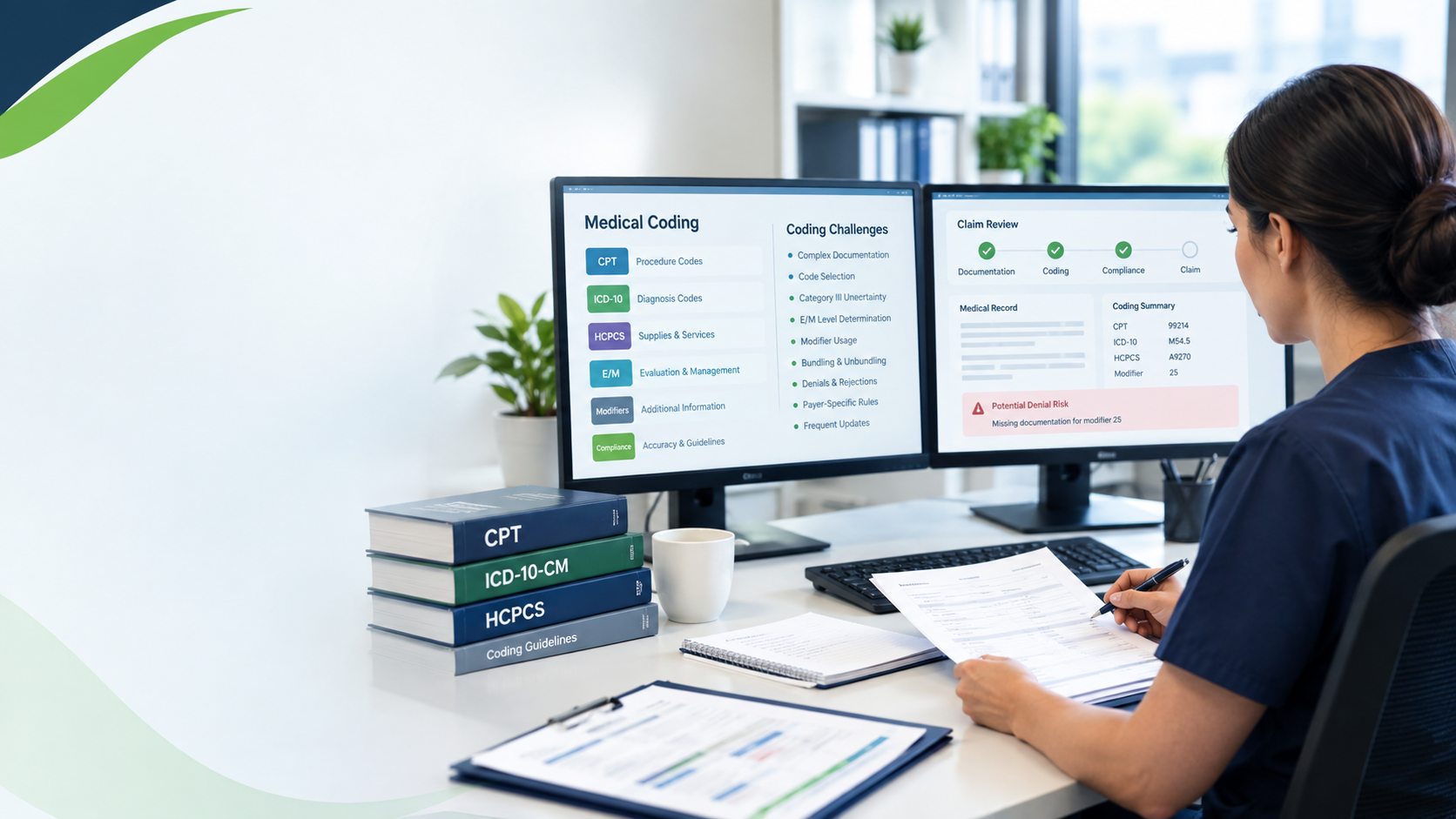

Medical coding may look simple from the outside: review the documentation, find a code, and submit the claim.
In reality, accurate medical coding requires a detailed understanding of clinical documentation, CPT, HCPCS, ICD-10-CM, E/M guidelines, modifiers, payer requirements, and coding compliance.
A small mistake in code selection can result in a claim denial, delayed reimbursement, incorrect payment, or compliance concerns.
At QuanXelis, we understand that effective coding is not simply about assigning codes. It is about making sure the documentation, coding, and billing process work together accurately.
1. CPT Coding
CPT codes are used to report medical procedures and professional services performed by healthcare providers.
The challenge
The difficulty is often not finding a CPT code, but determining which code most accurately represents the service documented by the provider.
Common issues include:
- Selecting a code that does not fully represent the documented service
- Choosing between similar CPT codes
- Missing required documentation
- Incorrectly applying coding guidelines
- Incorrect bundling or unbundling
- Using outdated coding information
Our approach focuses on reviewing the documentation carefully and selecting codes based on the services actually supported by the record.
2. HCPCS & ICD-10-CM Coding
HCPCS codes are commonly used for products, supplies, medications, equipment, and certain services that may not be represented by CPT.
ICD-10-CM codes describe the patient’s diagnoses and medical conditions.
The challenge
Accurate diagnosis and HCPCS coding requires understanding the relationship between:
Documentation → Diagnosis → Procedure/Service → Code → Payer Requirements
Common challenges include:
- Selecting the appropriate diagnosis code
- Understanding specificity requirements
- Connecting diagnoses appropriately to services
- Selecting the correct HCPCS code
- Handling payer-specific requirements
- Avoiding unsupported or insufficiently documented codes
We review the documentation and coding requirements together rather than treating diagnosis and procedure coding as completely separate processes.
3. CPT Category III Coding
CPT Category III codes are temporary codes used to report emerging technologies, procedures, and services.
Why can Category III coding be challenging?
These codes may involve newer or less commonly performed services, which means coders need to understand:
- The exact service being performed
- The purpose of the procedure
- Documentation requirements
- Code descriptors
- Applicable coding guidelines
- Payer-specific policies
- Whether another code may be more appropriate
Category III coding should not be approached simply by matching keywords. The actual service and documentation need to support the selected code.
4. E/M Level Selection
Evaluation and Management (E/M) coding is another area where accuracy is extremely important.
The correct E/M level depends on the applicable coding guidelines and the documentation supporting the encounter.
Common challenges include:
- Selecting the appropriate level
- Understanding Medical Decision Making (MDM)
- Reviewing problems addressed
- Evaluating data reviewed and analyzed
- Considering risk
- Understanding time-based coding when applicable
- Avoiding upcoding or downcoding
Our focus is on making sure the selected E/M level is supported by the documentation, rather than selecting a higher level simply because it may result in greater reimbursement.
5. Complex or Incomplete Documentation
One of the biggest challenges in medical coding is documentation that does not clearly support the service provided.
For example, documentation may:
- Lack necessary clinical details
- Contain unclear terminology
- Fail to establish the reason for a service
- Have conflicting information
- Lack information needed for a specific code
- Not adequately support the level of service
In these situations, the coder should not simply assume what the provider intended.
The documentation must be reviewed carefully, and appropriate clarification processes should be followed when necessary.
6. Modifier Selection
Modifiers provide additional information about a procedure or service.
However, using the wrong modifier can create significant billing problems.
Common modifier challenges include:
- Knowing when a modifier is actually required
- Understanding modifier definitions
- Avoiding inappropriate modifier use
- Distinguishing between similar modifiers
- Supporting the modifier with documentation
- Understanding payer-specific rules
Our coding process includes reviewing the circumstances of the service before applying a modifier.
7. Coding Compliance
Coding accuracy and compliance go hand in hand.
A claim should accurately represent the services documented in the medical record.
Potential compliance concerns can arise from:
- Upcoding
- Unbundling
- Unsupported diagnoses
- Incorrect modifier use
- Insufficient documentation
- Incorrect E/M selection
- Repeated coding patterns that do not align with documentation
Our approach is documentation-driven: code what is supported, follow applicable guidelines, and avoid assumptions.
8. Bundling & Unbundling Issues
Some services may be considered part of another procedure under applicable coding rules.
This is where bundling and unbundling become important.
The challenge
A coder needs to understand when services can be separately reported and when they are considered included in another service.
Incorrectly separating bundled services can result in:
- Claim denials
- Incorrect reimbursement
- Payer disputes
- Compliance concerns
We review the procedures and applicable coding guidance before determining whether services should be separately reported.
9. Denials Caused by Coding Issues
A denied claim does not always mean the service was wrong.
Sometimes the problem is the way the service was coded or documented.
Coding-related denial causes can include:
- Incorrect CPT code
- Incorrect ICD-10-CM code
- Invalid modifier
- Diagnosis/procedure mismatch
- Insufficient documentation
- Incorrect E/M level
- Payer-specific coding requirements
- Incorrect or outdated coding information
Our process focuses on identifying the reason behind the denial, correcting the underlying issue when appropriate, and reducing repeat errors.
How We Approach Medical Coding
At QuanXelis, our goal is not simply to assign codes.
We look at the complete picture:
Documentation → Coding → Compliance → Claim Accuracy → Reimbursement
Our medical coding support includes:
- CPT coding
- HCPCS coding
- ICD-10-CM coding
- CPT Category III coding
- E/M level review
- Modifier review
- Documentation review
- Coding compliance review
- Bundling and unbundling review
- Coding-related denial analysis
- Payer-specific coding considerations
We understand that every specialty and healthcare organization can have different documentation patterns, services, and payer requirements.
That is why our approach is based on careful documentation review and accurate code selection, rather than simply searching for the closest code.
The Goal
The goal of accurate medical coding is not to maximize the code.
It is to make sure the code accurately represents the documented service and diagnosis while following applicable coding and payer requirements.
Better coding can support:
Accurate Claims | Fewer Coding Errors | Better Compliance | Cleaner Billing | More Efficient Revenue Cycle
Medical coding is detailed work, and the details matter.
What is the biggest coding challenge your practice or organization faces today — CPT selection, E/M levels, modifiers, documentation, Category III codes, or denials?