

Table of Contents
- Introduction
- What Is ICD-10?
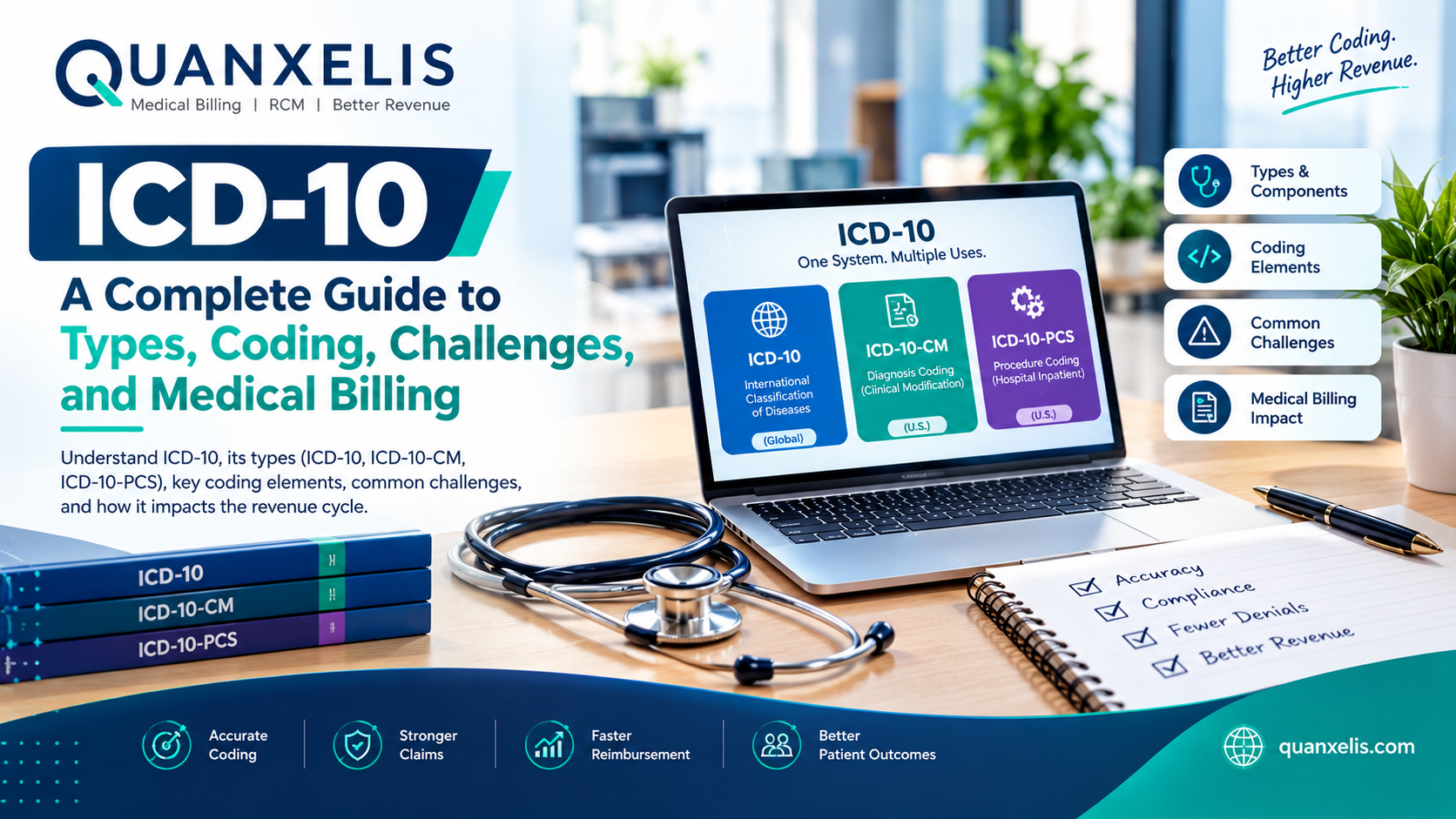
- ICD-10 vs. ICD-10-CM vs. ICD-10-PCS
- Major ICD-10 Categories and Chapters
- How Is an ICD-10-CM Code Structured?
- How Does ICD-10 Coding Work?
- ICD-10 and Medical Billing
- Common ICD-10 Coding Challenges
- How to Improve ICD-10 Coding Accuracy
- ICD-10 vs. CPT
- Final Thoughts
- Key Takeaways
Introduction
Accurate medical coding is one of the foundations of an efficient healthcare revenue cycle. Every patient encounter generates clinical information, but insurance companies, healthcare organizations, government programs, and health information systems need that information in a standardized format.
This is where ICD-10 comes in.
ICD-10 stands for International Classification of Diseases, 10th Revision. It is a standardized classification system used to identify diseases, disorders, injuries, symptoms, health conditions, and other reasons for healthcare encounters.
ICD-10 provides a common language for describing diagnoses and health conditions. In the United States, ICD-10 has been adapted into systems used for diagnosis and inpatient procedure coding. CMS explains that the U.S. system includes ICD-10-CM for diagnoses and ICD-10-PCS for inpatient hospital procedures.
For medical billing and revenue cycle management, ICD-10 is especially important because diagnosis codes help communicate why a service was medically necessary and provide important information for claim processing.
What Is ICD-10?
ICD-10 is the tenth revision of the International Classification of Diseases developed under the World Health Organization (WHO).
The WHO’s ICD system is used to classify diseases and other health conditions and supports standardized health information and statistics. ICD-10 uses an alphanumeric structure and organizes conditions into chapters, categories, and subcategories.
The international ICD-10 classification should not be confused with every national modification of ICD-10.
Different countries can adapt the classification for their healthcare systems.
For example, the United States uses ICD-10-CM, a clinical modification for diagnosis coding, and ICD-10-PCS, a procedure coding system for inpatient hospital procedures.
Why Was ICD-10 Introduced?
Healthcare became increasingly complex, and older coding systems did not always provide enough detail to accurately describe modern diseases, conditions, and procedures.
In the United States, the healthcare industry transitioned from ICD-9 to ICD-10 for diagnosis and inpatient procedure coding on October 1, 2015. The transition provided substantially greater specificity for classifying health conditions and inpatient procedures.
The additional detail allows healthcare organizations to describe conditions more precisely and supports:
- Medical billing
- Claims processing
- Medical necessity documentation
- Healthcare analytics
- Public health reporting
- Quality measurement
- Research
- Healthcare planning
- Patient record management
ICD-10 vs. ICD-10-CM vs. ICD-10-PCS
One of the most common areas of confusion is treating ICD-10, ICD-10-CM, and ICD-10-PCS as if they were exactly the same thing.
They are related, but they have different purposes.
1. ICD-10
ICD-10 is the international classification developed by WHO.
It provides the foundation for classifying diseases, health conditions, injuries, symptoms, and other health-related conditions.
The WHO’s ICD-10 classification contains chapters covering areas such as infectious diseases, neoplasms, mental and behavioral disorders, circulatory diseases, respiratory diseases, injuries, external causes, and factors affecting health status.
2. ICD-10-CM
ICD-10-CM stands for International Classification of Diseases, Tenth Revision, Clinical Modification.
It is the U.S. diagnosis classification system.
ICD-10-CM is used to code diagnoses and conditions in healthcare settings throughout the United States. It is maintained by the CDC’s National Center for Health Statistics (NCHS).
For most medical billing situations involving physician offices, outpatient clinics, behavioral health practices, and other healthcare providers, ICD-10-CM is the diagnosis coding system you will encounter.
Examples of information represented by ICD-10-CM can include:
- Diseases
- Symptoms
- Injuries
- Chronic conditions
- Mental and behavioral health conditions
- Pregnancy-related conditions
- Preventive or examination encounters
- Factors affecting health status
- External causes of injuries
3. ICD-10-PCS
ICD-10-PCS stands for International Classification of Diseases, Tenth Revision, Procedure Coding System.
It is used primarily for procedures performed in U.S. hospital inpatient settings.
ICD-10-PCS was developed and is maintained by CMS. Unlike ICD-10-CM, which describes diagnoses, ICD-10-PCS describes inpatient hospital procedures.
ICD-10-PCS codes contain seven alphanumeric characters, with each character providing information about the procedure. The system includes concepts such as body system, root operation, body part, approach, device, and qualifier.
What Are the Main Types of ICD-10?
When discussing ICD-10 in healthcare, the most important classifications to understand are:
ICD-10
The international disease classification maintained by WHO.
ICD-10-CM
The U.S. clinical modification used for diagnosis coding.
ICD-10-PCS
The U.S. inpatient procedure coding system.
It is also important to understand that ICD-10-CM itself contains many different categories of diagnoses, organized into chapters.
Major ICD-10 Categories and Chapters
The WHO ICD-10 classification is organized into chapters covering different groups of conditions.
Some major areas include:
Chapter I – Infectious and Parasitic Diseases
Codes: A00-B99
This category includes conditions caused by infectious organisms and parasites.
Examples include:
- Cholera
- Tuberculosis
- Certain viral infections
- Intestinal infections
- Parasitic diseases
Chapter II – Neoplasms
Codes: C00-D48
This chapter covers neoplasms, including malignant and certain benign or uncertain tumors.
Chapter III – Diseases of the Blood and Blood-Forming Organs
Codes: D50-D89
This includes conditions affecting blood and blood-forming organs, as well as certain immune-related disorders.
Chapter IV – Endocrine, Nutritional and Metabolic Diseases
Codes: E00-E90
Examples include:
- Diabetes
- Thyroid disorders
- Nutritional deficiencies
- Metabolic disorders
Chapter V – Mental and Behavioral Disorders
Codes: F00-F99
This chapter includes classifications for many mental and behavioral disorders.
This area is particularly relevant to behavioral health providers, psychiatrists, psychologists, therapists, and other mental health professionals.
Chapter VI – Diseases of the Nervous System
Codes: G00-G99
Examples include various neurological disorders and diseases affecting the nervous system.
Chapter VII – Diseases of the Eye and Adnexa
Codes: H00-H59
This chapter covers diseases and disorders affecting the eye and related structures.
Chapter VIII – Diseases of the Ear and Mastoid Process
Codes: H60-H95
This includes conditions involving the external, middle, and inner ear.
Chapter IX – Diseases of the Circulatory System
Codes: I00-I99
Examples include:
- Hypertension
- Heart diseases
- Cerebrovascular diseases
- Other circulatory conditions
Chapter X – Diseases of the Respiratory System
Codes: J00-J99
Examples include:
- Asthma
- Pneumonia
- Chronic respiratory diseases
- Other respiratory conditions
Chapter XI – Diseases of the Digestive System
Codes: K00-K93
This includes diseases involving the digestive tract and related organs.
Chapter XII – Diseases of the Skin and Subcutaneous Tissue
Codes: L00-L99
This chapter covers dermatological conditions and disorders affecting the skin and subcutaneous tissue.
Chapter XIII – Diseases of the Musculoskeletal System
Codes: M00-M99
Examples include:
- Arthritis
- Joint disorders
- Muscle disorders
- Connective tissue conditions
Chapter XIV – Diseases of the Genitourinary System
Codes: N00-N99
This includes diseases affecting the urinary and reproductive systems.
Chapter XV – Pregnancy, Childbirth and the Puerperium
Codes: O00-O99
This chapter covers conditions related to pregnancy, childbirth, and the postpartum period.
Chapter XVI – Conditions Originating in the Perinatal Period
Codes: P00-P96
This chapter covers certain conditions originating around the time of birth.
Chapter XVII – Congenital Malformations and Chromosomal Abnormalities
Codes: Q00-Q99
This chapter includes congenital conditions, malformations, deformations, and chromosomal abnormalities.
Chapter XVIII – Symptoms, Signs and Abnormal Clinical Findings
Codes: R00-R99
These codes can be used for symptoms, signs, and abnormal findings when a definitive diagnosis has not been established or when the coding guidelines permit their use.
Chapter XIX – Injury, Poisoning and Certain Other Consequences of External Causes
Codes: S00-T98
This chapter covers injuries, poisoning, and other consequences of external causes.
Chapter XX – External Causes of Morbidity and Mortality
Codes: V01-Y98
These codes provide information about external causes and circumstances associated with injuries and other health conditions.
Chapter XXI – Factors Influencing Health Status and Contact With Health Services
Codes: Z00-Z99
Z codes can describe situations such as:
- Routine examinations
- Screening
- Follow-up care
- Counseling
- History of certain conditions
- Other circumstances affecting healthcare encounters
The WHO classification describes this chapter as covering factors related to health status and contact with healthcare services.
How Is an ICD-10-CM Code Structured?
ICD-10-CM codes are alphanumeric.
A code may contain between three and seven characters depending on the level of specificity required.
The structure generally begins with a letter followed by numbers and may include additional characters after a decimal point.
For example:
E11.9
This represents a specific diagnosis category within ICD-10-CM.
The important point is that coders should not select a code simply because its description sounds close to the diagnosis.
The complete coding system must be reviewed.
Why Specificity Matters in ICD-10 Coding
One of the major advantages of ICD-10-CM is its ability to capture clinical detail.
Depending on the diagnosis, the code may require information such as:
- Anatomical location
- Laterality
- Severity
- Type of condition
- Acute or chronic status
- Encounter information
- Complications
- Associated conditions
- Specific circumstances
This means that more documentation does not automatically mean more codes.
Instead, documentation should support the correct level of specificity.
How Does ICD-10 Coding Work?
The coding process generally begins with the patient’s medical record.
A simplified workflow looks like this:
Step 1: Review the Medical Documentation
The coder reviews the documentation from the encounter.
This can include:
- Provider notes
- Assessment
- Diagnoses
- Treatment information
- Test results
- Relevant history
- Other clinical documentation
Step 2: Identify the Diagnosis
The coder determines what condition, symptom, reason for encounter, or other reportable diagnosis is supported by the documentation.
Step 3: Locate the Diagnosis in the Alphabetic Index
The coder can begin by locating the documented condition in the ICD-10-CM Alphabetic Index.
However, finding a term in the Index is not necessarily the end of the process.
Step 4: Verify the Code in the Tabular List
The selected code should then be verified in the Tabular List.
This is extremely important because the Tabular List contains instructions, inclusion terms, exclusion notes, and other coding information.
The official ICD-10-CM guidelines emphasize the importance of using both the Alphabetic Index and Tabular List and following the classification’s conventions and instructions.
Step 5: Check for Required Specificity
The coder determines whether the documentation supports additional specificity.
This may involve checking:
- Laterality
- Anatomical site
- Severity
- Encounter type
- Associated conditions
- Other required characters
Step 6: Apply Coding Guidelines
The coder applies the official coding guidelines and conventions relevant to the case.
Step 7: Sequence the Diagnosis Correctly
Depending on the healthcare setting, the order of diagnoses can matter.
For example, inpatient coding and outpatient coding have different rules concerning diagnosis reporting and sequencing.
Step 8: Submit the Claim
The diagnosis information is then incorporated into the appropriate claim and submitted with other required billing information.
The payer uses the information during claim processing, including evaluating the relationship between the services reported and the diagnoses submitted.
ICD-10 and Medical Billing
ICD-10 does not work alone in a medical claim.
A claim typically contains several types of information.
For example:
CPT/HCPCS → What service was performed
ICD-10-CM → Why the service was performed
Other claim information can include:
- Patient information
- Provider information
- Place of service
- Date of service
- Modifiers
- Insurance information
- Units
- Charges
The diagnosis code helps establish the clinical reason associated with the service.
This is why diagnosis coding is an important part of the revenue cycle.
ICD-10 and Medical Necessity
Medical necessity is an important concept in healthcare reimbursement.
A payer may evaluate whether the service billed is supported by the diagnosis and documentation.
For example, if a provider submits a service but the diagnosis information does not appropriately support the service under the payer’s rules, the claim may face additional review or denial.
This does not mean that every claim with a particular diagnosis will automatically be paid.
Coverage policies, payer rules, documentation, authorization requirements, coding, and other factors can all affect reimbursement.
Common ICD-10 Coding Challenges
ICD-10 provides much more detail than many older coding systems, but that detail also creates challenges.
1. Incomplete Documentation
One of the biggest challenges is insufficient clinical documentation.
If the provider documentation does not clearly establish the diagnosis or required details, the coder may not be able to select the most specific supported code.
The official ICD-10-CM guidelines emphasize that accurate coding depends on complete and accurate documentation.
2. Choosing an Unspecified Code
Unspecified codes are sometimes appropriate.
However, they should not be selected simply because they are easier.
If the medical record contains sufficient information for a more specific code, the available specificity should be considered.
3. Confusing Similar Diagnoses
Some diagnoses have very similar terminology.
A coder must understand the provider’s documentation and the distinctions between related conditions.
Selecting a code based only on a familiar keyword can result in inaccurate coding.
4. Incorrect Use of the Alphabetic Index
The Alphabetic Index is an important starting point, but stopping there can create errors.
The selected code must be verified in the Tabular List and checked against the applicable instructions.
5. Ignoring Exclusion Notes
ICD-10 contains exclusion notes that help prevent inappropriate code combinations.
Ignoring these instructions can lead to incorrect coding.
6. Missing Laterality
Some diagnoses require the coder to identify whether the condition affects the:
- Right side
- Left side
- Both sides
If laterality is required and documented, it should be considered when selecting the code.
7. Incorrect Sequencing
Reporting the correct diagnoses in the wrong order can create problems, particularly when specific sequencing rules apply.
8. Using an Outdated Code Set
ICD-10 code sets are updated.
Using outdated codes can lead to coding errors and claim problems.
For the United States, CMS publishes annual ICD-10-CM and ICD-10-PCS updates. CMS has announced that the FY 2027 ICD-10-CM and ICD-10-PCS updates become effective October 1, 2026.
ICD-10 Updates and Why They Matter
ICD-10 is not a static list.
Codes can be:
- Added
- Deleted
- Revised
- Expanded
- Reorganized
Healthcare organizations and coding teams therefore need a process for monitoring annual updates.
As of October 1, 2026, the U.S. FY 2027 ICD-10-CM and ICD-10-PCS files apply to the relevant encounters and discharges specified by CMS.
This makes version control particularly important.
A coding team should always confirm that it is working with the code set applicable to the date of service or discharge.
ICD-10 and Claim Denials
Incorrect diagnosis coding can contribute to claim problems.
Common issues include:
- Invalid or outdated codes
- Diagnosis does not support the reported service
- Insufficient specificity
- Incorrect sequencing
- Documentation mismatch
- Incorrect code combination
- Missing required information
- Payer-specific requirements
- Authorization or coverage issues
However, it is important to remember that not every denial is a coding denial.
A claim can also be denied because of:
- Eligibility
- Prior authorization
- Credentialing
- Timely filing
- Incorrect patient information
- Coordination of benefits
- Provider enrollment
- Coverage limitations
- Missing documentation
This is why denial management should look at the entire claim rather than automatically blaming ICD-10 coding.
ICD-10 Challenges for Medical Billers
Medical billers frequently work between clinical documentation, coding, and payer requirements.
Some common challenges include:
Documentation and Coding Mismatch
The diagnosis submitted on the claim may not accurately reflect the provider’s documentation.
Payer-Specific Rules
Different payers can have different coverage and claim-processing requirements.
Frequent Code Updates
Billing teams must stay current with annual code-set changes.
Denial Follow-Up
When a claim is denied, the billing team may need to determine whether the problem was related to coding, documentation, coverage, authorization, or another issue.
Communication With Providers
When documentation is unclear, billing and coding teams may need to communicate with the provider to clarify the record through appropriate processes.
ICD-10 Challenges for Healthcare Providers
Providers also play an important role in accurate coding.
A provider’s documentation should clearly communicate the patient’s relevant diagnoses and the clinical circumstances of the encounter.
Common documentation challenges include:
- Missing specificity
- Ambiguous terminology
- Incomplete assessment
- Missing supporting details
- Inconsistent documentation
- Failure to update diagnoses appropriately
- Documentation that does not clearly support the services provided
Better documentation can make the coding process more efficient and reduce unnecessary back-and-forth.
ICD-10 in Behavioral Health
ICD-10-CM is particularly important in behavioral healthcare.
Psychiatrists, psychologists, therapists, psychiatric nurse practitioners, and other behavioral health professionals may use diagnosis codes to report conditions addressed during patient encounters.
Behavioral health coding can require careful attention to:
- The provider’s documented diagnosis
- Symptoms and clinical findings
- Treatment documentation
- Specificity
- Payer requirements
- Telehealth requirements
- Documentation consistency
Because behavioral health claims can involve recurring services, maintaining consistent and accurate documentation is especially important.
ICD-10 and Telehealth
Telehealth has created additional operational considerations for healthcare organizations.
While ICD-10-CM continues to identify the diagnosis or reason for the encounter, other claim elements may be needed to accurately report how and where the service was provided.
This means healthcare organizations should not treat diagnosis coding as the only component of telehealth claim accuracy.
The diagnosis, procedure code, modifiers, place of service, payer rules, and documentation should all be reviewed according to the applicable requirements.
Common ICD-10 Coding Mistakes
Here are some mistakes healthcare organizations should watch for:
Mistake 1: Choosing a Code Based Only on a Keyword
A diagnosis term may have multiple possible codes.
Mistake 2: Not Reviewing the Tabular List
Finding a code in the Index is not enough.
Mistake 3: Ignoring Coding Instructions
Excludes notes, inclusion terms, and other instructions can affect code selection.
Mistake 4: Using an Outdated Code
Always verify the applicable code-set year.
Mistake 5: Coding Beyond the Documentation
Coders should not add clinical information that is not supported by the medical record.
Mistake 6: Automatically Choosing an Unspecified Code
If the documentation supports greater specificity, the coder should evaluate the more specific option.
Mistake 7: Assuming Every Denial Is an ICD-10 Problem
Denials can have many different causes.
How to Improve ICD-10 Coding Accuracy
Healthcare organizations can take several practical steps.
Keep Code Sets Updated
Make sure coding staff have access to the current applicable ICD-10-CM and, where relevant, ICD-10-PCS files.
Review Documentation Before Coding
Coding should be based on the complete relevant medical record rather than isolated phrases.
Use the Alphabetic Index and Tabular List
Do not rely solely on a code-search tool or keyword search.
Train Staff Regularly
Regular training helps coding and billing teams stay current with:
- New codes
- Deleted codes
- Revised guidelines
- Documentation requirements
- Payer changes
Perform Regular Audits
Internal coding audits can identify patterns such as:
- Repeated unspecified coding
- Incorrect sequencing
- Documentation gaps
- Frequently denied diagnosis combinations
- Outdated codes
Analyze Denials
Denial data can reveal recurring operational problems.
For example, if the same diagnosis-related issue appears repeatedly, the organization can investigate whether the root cause is:
Documentation → Coding → Claim submission → Payer processing
Finding the root cause is more useful than simply resubmitting claims repeatedly.
ICD-10 Coding Workflow in Revenue Cycle Management
A well-organized RCM workflow can look like this:
Patient Encounter
↓
Provider Documentation
↓
Diagnosis Identification
↓
ICD-10-CM Code Selection
↓
Code Verification
↓
CPT/HCPCS + ICD-10 Review
↓
Claim Scrubbing
↓
Claim Submission
↓
Payer Adjudication
↓
Payment or Denial
↓
Denial Analysis
↓
Correction / Appeal / Follow-Up
This shows why ICD-10 is not an isolated coding task.
It is connected to multiple stages of the revenue cycle.
ICD-10 vs. CPT: What Is the Difference?
This is one of the most important concepts for anyone new to medical billing.
| Coding System | Main Purpose |
| ICD-10-CM | Describes diagnoses and health conditions |
| ICD-10-PCS | Describes inpatient hospital procedures in the U.S. |
| CPT | Describes many professional services and procedures |
| HCPCS Level II | Describes products, supplies, services, and other items not represented by CPT |
A simple way to remember it is:
ICD-10-CM = Why?
CPT/HCPCS = What?
For example, the diagnosis code can communicate the condition being treated, while the CPT code can communicate the professional service performed.
For additional background, the American Medical Association explains the role of CPT, while CMS provides information about HCPCS Level II codes.
Why Accurate ICD-10 Coding Matters
Accurate ICD-10 coding affects more than claims.
It can support:
Better Claims
Accurate diagnosis information helps create cleaner claims.
Better Documentation
Coding requirements can encourage more complete clinical documentation.
Better Data
Standardized diagnosis information supports healthcare analytics and reporting.
Better Revenue Cycle Management
Accurate coding can help reduce avoidable claim problems and unnecessary rework.
Better Communication
Standardized codes allow different organizations to communicate clinical information more consistently.
Better Healthcare Analysis
ICD classifications are also used for health statistics, quality measurement, research, and public health activities.
What Makes ICD-10 Difficult?
The biggest challenge is not simply remembering codes.
The real challenge is understanding the relationship between:
Clinical Documentation + Coding Guidelines + Code Selection + Payer Requirements + Claim Submission
A coder may know thousands of codes, but accurate coding still depends on understanding the documentation and applying the correct rules.
That is why effective coding requires both technical knowledge and attention to detail.
A Practical ICD-10 Checklist
Before a claim is submitted, a billing or coding team can ask:
- Is the diagnosis supported by the documentation?
- Is the code current?
- Is the code valid for the applicable date of service?
- Is the code specific enough?
- Is laterality required?
- Were the Alphabetic Index and Tabular List reviewed?
- Are there exclusion or inclusion instructions?
- Is the diagnosis sequenced appropriately?
- Does the diagnosis support the service being reported?
- Are CPT/HCPCS and ICD-10 information consistent?
- Are payer-specific requirements satisfied?
- Has the claim been reviewed for common errors?
The Future of ICD-10 Coding
Healthcare organizations are increasingly using technology to support coding and revenue cycle workflows.
Technology can assist with:
- Code lookup
- Documentation review
- Claim scrubbing
- Denial identification
- Data validation
- Workflow automation
- Reporting
- Analytics
- Coding quality monitoring
However, automation should support qualified coding and billing processes rather than replacing professional judgment.
ICD-10 itself also continues to evolve. WHO has moved to ICD-11 internationally, which officially came into effect in 2022, while the United States continues to use its ICD-10-CM and ICD-10-PCS systems for the applicable coding requirements.
Final Thoughts
ICD-10 is much more than a list of diagnosis codes.
It is a standardized system that helps transform clinical information into structured data that can be used across healthcare.
For medical billing and revenue cycle management, accurate ICD-10-CM coding can play an important role in communicating the patient’s diagnosis, supporting claims, reducing avoidable errors, and improving the overall flow of the billing process.
The key is not simply to find a code that appears to match a diagnosis.
The goal is to select the correct, supported, current code according to the documentation and applicable coding guidelines.
When providers, coders, and billing teams work together, ICD-10 becomes more than a compliance requirement—it becomes an important part of an organized and efficient healthcare information and revenue cycle workflow.
Key Takeaways
ICD-10 is the international classification system for diseases and health conditions.
ICD-10-CM is the U.S. diagnosis coding system used across healthcare settings.
ICD-10-PCS is the U.S. procedure coding system used for inpatient hospital procedures.
Accurate coding depends on complete documentation, correct code selection, proper sequencing, current code sets, and adherence to official guidelines.
ICD-10 works together with other coding systems such as CPT and HCPCS rather than replacing them.
Finally, accurate coding is only one part of successful medical billing. Eligibility, authorization, documentation, credentialing, claim submission, payer rules, payment posting, and denial management can all affect the final outcome of a claim.