
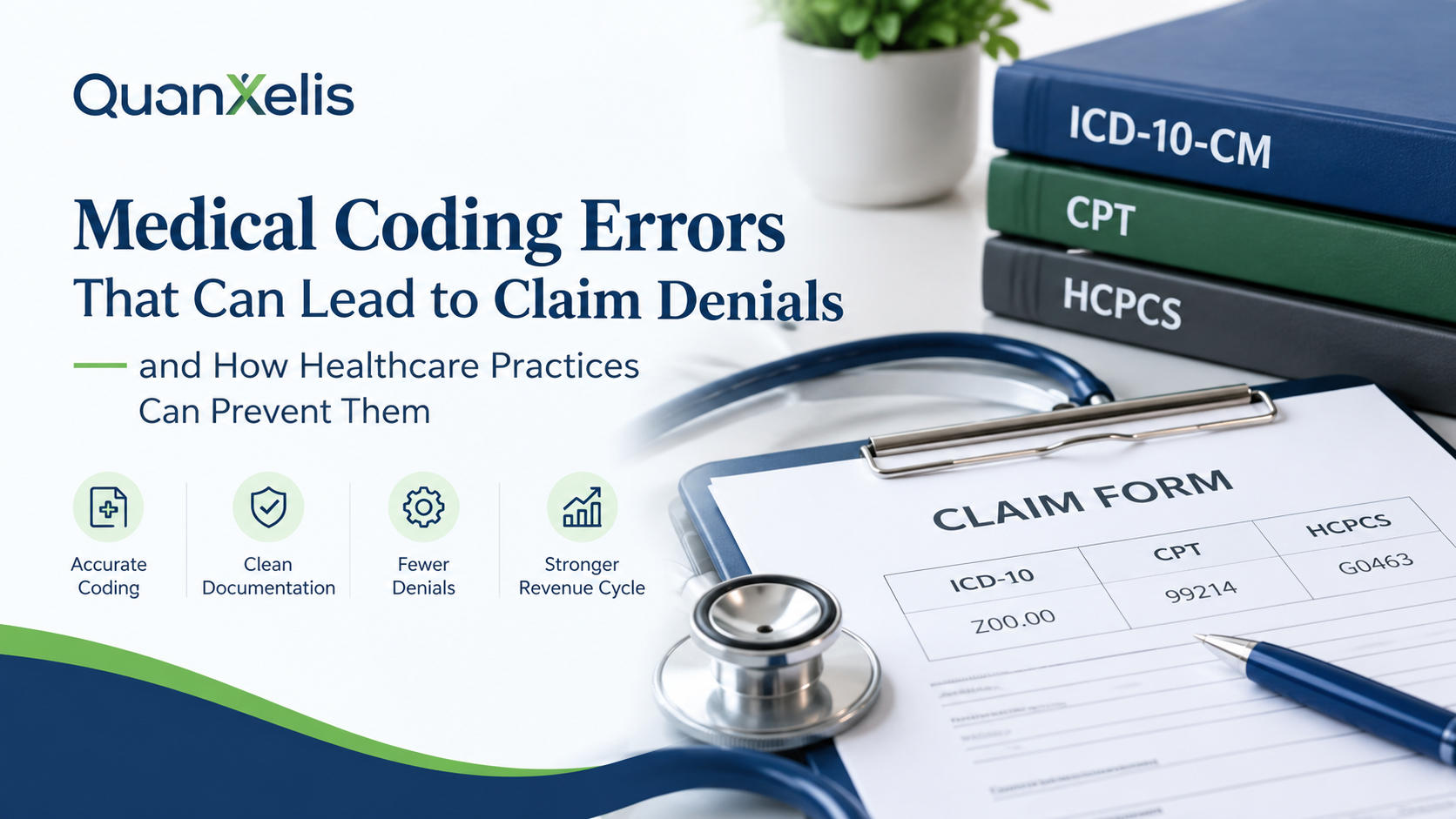

Medical coding plays an important role in the financial operations of a health care practice. Every submitted claim must accurately represent the services provided, the patient’s documented condition and the applicable coding and payer requirements. When a claim contains coding errors, incomplete documentation or inconsistent information, it may be denied, delayed or returned for correction.
For physicians, mental health professionals, outpatient clinics and other health care providers, recurring coding issues can create additional administrative work, delay reimbursement and make revenue cycle management more difficult.
The good news is that many preventable coding problems can be identified through consistent review, clear documentation procedures and an effective medical coding quality assurance process.
Why Medical Coding Accuracy Matters
Medical coding translates clinical documentation into standardized diagnosis and procedure codes. In the United States, ICD-10-CM is used to classify diagnoses, while CPT and HCPCS Level II codes describe many procedures, services, supplies and other reportable items.
Accurate coding helps communicate what happened during a patient encounter and supports the claim submission process. However, a correctly selected code does not automatically guarantee payment. Coverage, medical necessity, authorization, eligibility, timely filing and payer-specific policies can also affect claim outcomes.
When coding and documentation problems occur repeatedly, practices may spend more time correcting claims instead of focusing on patient care and practice operations.
7 Medical Coding Errors That Can Contribute to Claim Denials
1. Incorrect ICD-10-CM Diagnosis Codes
An incorrect diagnosis code may not accurately represent the condition documented in the medical record. Errors can arise from selecting a code that is too general, overlooking a required level of specificity or using an outdated code.
How to prevent it:
- Review the clinical documentation before assigning a diagnosis code.
- Verify code descriptions, inclusion notes, exclusions and applicable instructions in the official code set.
- Confirm that the code is valid for the date of service.
- Use the applicable fiscal year’s ICD-10-CM guidelines.
The Centers for Medicare & Medicaid Services provides official ICD-10 resources, including the fiscal year 2027 code files and guidelines applicable to encounters beginning Oct. 1, 2026.
2. Incorrect CPT or HCPCS Coding
CPT and HCPCS codes describe services, procedures, supplies and other reportable items. Selecting a code that does not match the service performed can lead to inaccurate claims and payer rejections or denials.
Coding errors may occur when staff rely on assumptions, select codes based only on a brief appointment description or overlook the distinction between similar services.
How to prevent it:
- Match the code to the actual service and supporting documentation.
- Check the applicable code descriptor and reporting instructions.
- Review payer policies and any relevant bundling or code-edit requirements.
- Confirm that the service meets applicable coverage and billing criteria.
Code selection should reflect the documented service, not the reimbursement amount a practice hopes to receive.
3. Incorrect or Missing Modifiers
Modifiers provide additional information about a service when their use is appropriate. Incorrect, missing or unsupported modifiers can cause claim-processing problems.
For example, modifier requirements may depend on the service, the circumstances of the encounter and the payer’s rules. A modifier should never be added simply because it appears likely to improve payment.
How to prevent it:
- Confirm that the underlying code permits the modifier.
- Review the documentation supporting its use.
- Check applicable National Correct Coding Initiative edits and payer-specific instructions.
- Review claims that repeatedly encounter modifier-related denials.
Modifiers must accurately represent the service and satisfy the applicable reporting requirements.
4. Incomplete or Inconsistent Clinical Documentation
Medical coding depends on the information recorded in the medical record. If the documentation does not support the reported diagnosis, service or level of detail, the claim may require correction or additional review.
Common problems include missing clinical details, conflicting information and documentation that does not adequately support the code selected.
How to prevent it:
- Establish consistent documentation standards for each provider type.
- Review records for missing or conflicting information before claim submission.
- Request clarification from the treating provider when appropriate.
- Never add unsupported diagnoses or alter documentation merely to justify a code.
Clinical documentation improvement should strengthen the accuracy and completeness of the record without compromising its integrity.
5. Unbundling and Incorrect Code Combinations
Some services are subject to coding edits that restrict reporting certain codes together or require specific conditions for separate reporting. Reporting services separately when applicable rules require them to be combined may create compliance and payment issues.
However, not every combination of codes is improper. The correct treatment depends on the services performed, applicable coding instructions, documentation and relevant exceptions.
How to prevent it:
- Review applicable National Correct Coding Initiative edits.
- Check the official code-set instructions and payer policies.
- Verify whether an exception or modifier is permitted and supported.
- Conduct periodic reviews of frequently billed code combinations.
A documented coding review process can help identify recurring errors before claims are submitted.
6. Missing or Incorrect Claim Information
Coding accuracy is only one part of a clean claim. Incorrect patient details, provider identifiers, dates of service or other required claim information can also cause processing delays or denials.
These issues may originate in registration, scheduling, documentation or billing workflows rather than in the code selection itself.
How to prevent it:
- Verify patient and insurance information.
- Confirm provider identifiers and enrollment status where relevant.
- Validate required claim fields before submission.
- Use a consistent pre-submission review process to identify missing or inconsistent information.
Clear communication between front-office staff, providers, coders and billing teams can help prevent errors from passing through multiple stages of the revenue cycle.
7. Failure to Follow Payer-Specific Coding Requirements
Different payers may have different coverage policies, authorization requirements, documentation standards and claim-submission rules. A code that is valid in the applicable code set does not necessarily establish that a service is covered under a particular plan.
For example, behavioral health practices may need to review requirements related to psychotherapy services, provider eligibility, authorization and documentation.
How to prevent it:
- Maintain current payer policy references.
- Verify authorization and eligibility requirements before services when applicable.
- Review denial reasons by payer and service type.
- Update internal procedures when relevant policies change.
Practices should distinguish coding errors from eligibility, authorization, coverage and other administrative denial reasons. Each requires an appropriate corrective action.
How Medical Coding Audits Help Identify Recurring Errors
A medical coding audit can help a practice evaluate whether its coding and documentation processes are working as intended. Rather than correcting claims individually without investigating the underlying cause, an audit can reveal recurring patterns that deserve attention.
A practical audit process may include:
- Define the scope. Select the provider, specialty, service type, payer or time period to review.
- Select records. Use an appropriate sample based on the audit objective and the practice’s risk areas.
- Review documentation. Compare the clinical record with the diagnosis codes, procedure codes, modifiers and submitted claim.
- Classify findings. Separate coding errors from documentation gaps, authorization problems, eligibility issues and other billing errors.
- Determine corrective actions. Identify whether the problem requires staff training, workflow changes, provider clarification or claim correction.
- Monitor results. Reassess the identified problem areas to determine whether corrective actions are working.
Audit findings should be documented clearly, and any corrections must follow applicable payer, recordkeeping and compliance requirements.
A Practical Medical Coding Quality Checklist
Before submitting a claim, a practice can use the following checklist as part of its internal review process:
- Confirm that the code set is valid for the date of service.
- Verify that diagnosis codes are supported by the clinical documentation.
- Confirm that CPT or HCPCS codes accurately describe the services performed.
- Review modifiers and applicable coding edits.
- Check patient, provider and insurance information.
- Verify authorization and coverage requirements where applicable.
- Confirm that required documentation is available.
- Review relevant payer-specific submission rules.
- Record recurring errors and monitor corrective actions.
This checklist is a general operational aid, not a substitute for official coding guidelines, payer policies or specialty-specific requirements.
When Should a Practice Consider Outsourced Medical Coding Services?
Outsourced medical coding may be worth evaluating when a practice experiences recurring coding errors, growing claim volumes, difficulty maintaining consistent review procedures or limited internal resources for coding quality assurance.
It can also be useful when a practice needs additional coding capacity or a more structured process for reviewing documentation and identifying recurring issues.
Before choosing a service provider, practice leaders should ask:
- Which specialties and code sets does the provider support?
- How are coding accuracy and documentation requirements reviewed?
- What quality assurance procedures are used?
- How are coding questions and documentation gaps escalated?
- How are errors, audit findings and corrective actions documented?
- What safeguards protect patient information?
- How will the provider coordinate with the practice’s existing billing and clinical workflows?
The right arrangement depends on the practice’s size, specialty, claim volume, internal capabilities and compliance requirements. Outsourcing should complement appropriate oversight rather than eliminate it.
How QuanXelis Supports Medical Coding Workflows
QuanXelis works to support health care operations through medical billing, credentialing, bookkeeping and technology services. Medical coding support can form part of a more coordinated approach to documentation review, coding accuracy and claim workflow management.
Our approach focuses on understanding the practice’s operational requirements, identifying workflow gaps and establishing a clear process for reviewing coding-related issues.
Depending on the agreed scope, medical coding support may include:
- Review of diagnosis and procedure coding against available documentation.
- Identification of recurring coding discrepancies.
- Assistance with coding quality checks and audit workflows.
- Coordination of coding-related findings with the billing process.
- Workflow improvements designed to support consistent claim preparation.
Every engagement should have a clearly defined scope, review responsibilities and appropriate safeguards for patient information. Service availability and deliverables should be confirmed before engagement.
Build a More Consistent Medical Coding Process
Medical coding errors can create avoidable administrative work and contribute to claim denials. Accurate code selection, complete documentation, appropriate modifier use, payer-policy review and regular quality checks can help practices identify problems earlier.
The most effective approach is not simply to correct individual claims. It is to identify recurring issues, address their causes and monitor whether the improvements are working.
Looking to strengthen your practice’s medical coding workflow?
QuanXelis can discuss your current coding and billing process, identify areas for review and help determine whether medical coding support or a structured quality assurance workflow fits your needs.
Visit quanxelis.com or email connect@quanxelis.com to start a conversation.
Sources and Further Reading
- Centers for Medicare & Medicaid Services: ICD-10 Codes and Official Guidelines
- Centers for Medicare & Medicaid Services: National Correct Coding Initiative
- American Medical Association: CPT Overview
This article provides general educational information and is not legal, clinical or payer-specific billing advice. Coding and coverage requirements vary by service, payer and date of service. Consult current official guidelines and applicable payer policies before submitting claims.