
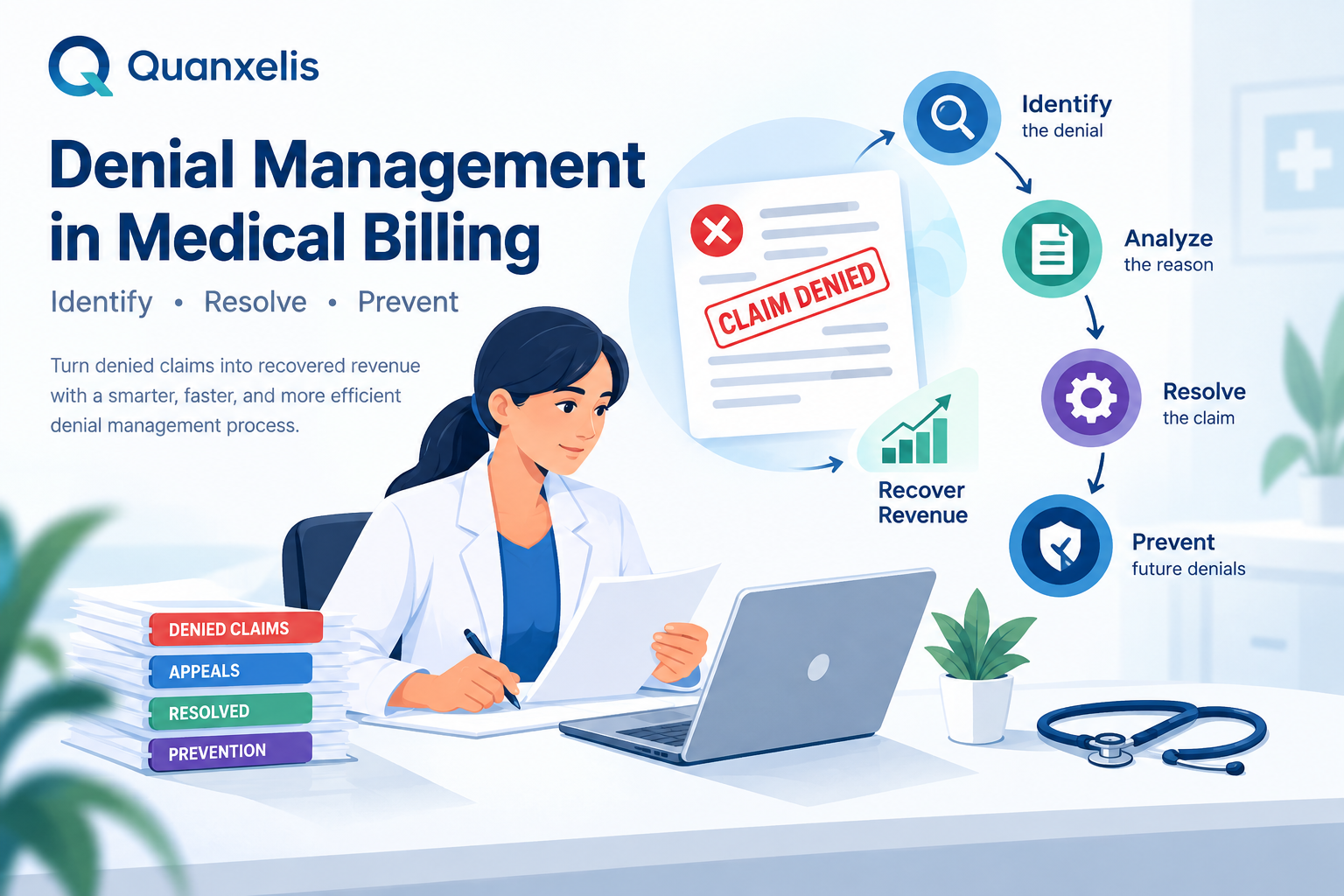

Medical billing denial management is one of the most important parts of the healthcare revenue cycle. A claim may be submitted correctly and still come back unpaid because of eligibility issues, authorization requirements, coding mistakes, documentation problems, medical necessity concerns, timely filing, coverage limitations, or payer-specific rules.
For a medical billing team, a denial is more than an unpaid claim. It is a signal that something in the revenue cycle needs to be reviewed.
Sometimes the problem is a simple billing error. Other times, the denial points to a larger issue in registration, authorization, coding, documentation, or communication between departments.
That is why effective medical billing denial management is not simply about correcting a denied claim and sending it again.
It is about understanding why the claim was denied, fixing the problem, recovering appropriate reimbursement, and preventing the same issue from happening again.
In this guide, we will walk through the complete denial management process, common denial reasons, denial codes, root-cause analysis, appeals, prevention strategies, KPIs, and practical tips that medical billing teams can use in their daily work.
What Is Medical Billing Denial Management?
Medical billing denial management is the process of identifying, reviewing, correcting, appealing, tracking, and preventing denied healthcare claims.
When an insurance payer does not approve payment for a submitted claim, the billing team needs to determine what happened and what action should be taken.
Depending on the situation, that action may involve:
- Correcting the claim
- Reviewing insurance eligibility
- Checking authorization
- Reviewing CPT or HCPCS coding
- Reviewing ICD-10-CM diagnosis coding
- Checking modifiers and units
- Reviewing medical documentation
- Sending additional records
- Submitting a corrected claim
- Requesting reconsideration
- Filing an appeal
- Contacting the payer
- Following up on the claim
However, good medical billing denial management goes one step further.
A billing department should also look for patterns.
If the same denial appears repeatedly, the team should ask:
Why does this keep happening?
That question can reveal a much bigger problem than an individual claim error.
For example, repeated authorization denials may indicate that the scheduling department does not have an effective authorization-checking process. Repeated coding denials may point to a training or documentation issue.
In other words, denial management has two jobs:
Recover the money that can appropriately be recovered.
And:
Improve the process so preventable denials happen less often.
Why Is Medical Billing Denial Management Important?
Healthcare organizations depend on timely and accurate reimbursement.
When claims are denied, payment may be delayed while staff investigate and resolve the issue. That creates additional work and can increase accounts-receivable aging.
Denials can involve several departments, including:
- Front-desk staff
- Registration
- Scheduling
- Eligibility teams
- Authorization teams
- Clinical staff
- Medical coders
- Medical billers
- A/R specialists
- Denial specialists
- Management
This is why denial management should not be viewed as the responsibility of only one person.
A claim may be denied in the billing department even though the original problem occurred much earlier in the revenue cycle.
For example:
Registration → Eligibility → Authorization → Documentation → Coding → Claim Submission → Payer Adjudication → Denial
The denial appears at the end of the process, but its cause may have started at the beginning.
That is one of the most important concepts in medical billing denial management.
Rejection vs. Denial: What Is the Difference?
The words rejection and denial are often used interchangeably, but they can represent different stages of claim processing.
What Is a Claim Rejection?
A rejection generally means a claim did not pass a required validation or submission check.
Examples can include:
- Invalid member information
- Missing required data
- Incorrect provider information
- Invalid claim formatting
- Clearinghouse errors
- Electronic data issues
Depending on the situation, the claim may need to be corrected and resubmitted.
What Is a Claim Denial?
A denial generally occurs after the payer has evaluated the claim and determines that payment will not be made, either fully or partially.
Examples include:
- Authorization was not obtained
- Service is not covered
- Medical necessity requirements were not met
- Documentation was insufficient
- Coding was incorrect
- Claim was submitted after the applicable deadline
- Claim was considered a duplicate
The exact meaning and appropriate next step depend on the payer, plan, claim type, and reason for the denial.
Understanding this distinction helps a billing team decide whether it needs to correct a submission problem or work a payer adjudication issue.
Common Types of Medical Billing Denials
There is no single reason why healthcare claims are denied.
Understanding the major denial categories makes it easier to investigate claims and identify recurring problems.
1. Eligibility Denials
Eligibility denials happen when there is a problem with the patient’s insurance coverage or the information submitted on the claim.
Common causes include:
- Coverage was terminated
- Patient was not eligible on the date of service
- Incorrect member ID
- Incorrect payer
- Incorrect subscriber information
- Coordination of benefits issue
- Incorrect patient relationship to subscriber
Eligibility should be verified before services are provided whenever possible.
However, an eligibility response does not guarantee that a claim will ultimately be paid. Other requirements can still apply.
2. Authorization Denials
Authorization-related denials occur when the payer requires prior authorization or another form of approval and the requirement was not satisfied.
Possible reasons include:
- Authorization was never obtained
- Authorization expired
- Incorrect authorization number
- Wrong procedure was authorized
- Wrong provider was authorized
- Wrong facility was authorized
- Service date was outside the authorization period
- Authorized units were exceeded
Authorization problems are often best addressed before the claim is submitted.
A clear authorization workflow should identify who is responsible for obtaining the authorization, when it needs to be obtained, and where the authorization information is stored.
3. Coding Denials
Coding errors can also lead to claim denials.
Common examples include:
- Incorrect CPT code
- Incorrect HCPCS code
- Incorrect ICD-10-CM code
- Incorrect modifier
- Incorrect units
- Incorrect place of service
- Incorrect code combination
- Bundling issues
- Diagnosis-to-procedure issues
Coding should always be based on the actual documentation and applicable coding requirements.
For Medicare, CMS maintains National Correct Coding Initiative resources that include Procedure-to-Procedure edits and Medically Unlikely Edits.
[External Resource: CMS National Correct Coding Initiative]
4. Medical Necessity Denials
A medical necessity denial generally means the payer determined that the submitted information did not establish coverage or medical necessity under the applicable policy.
Resolving this type of denial may require reviewing:
- Medical records
- Clinical notes
- Diagnosis
- Treatment plan
- Test results
- Procedure documentation
- Payer medical policy
The billing team should not assume that simply changing a diagnosis code will solve the problem.
The documentation and applicable payer requirements need to be reviewed first.
5. Documentation Denials
Documentation is an important part of claim support.
A claim may encounter a documentation-related problem when required information is:
- Missing
- Incomplete
- Unsigned
- Submitted late
- Not received
- Inconsistent with the service billed
The specific documentation requirements depend on the service and payer.
For certain Medicare review situations, CMS explains that failure to provide requested documentation can result in a denial.
6. Timely Filing Denials
Timely filing refers to the deadline for submitting a claim to the payer.
A claim may be denied when it is submitted after the applicable filing period.
The important point is that timely filing requirements are not necessarily the same for every payer.
Billing teams should maintain payer-specific information rather than relying on one general deadline.
For Medicare fee-for-service, specific filing rules and exceptions are established by CMS.
Before appealing a timely filing denial, review the payer’s applicable rules and determine whether an exception or reconsideration process is available.
7. Duplicate Claim Denials
A duplicate denial means the payer believes the claim or service has already been submitted or processed.
Before submitting the claim again, review:
- Previous submissions
- Claim status
- Payment history
- Payer response
- Corrected-claim requirements
Repeatedly submitting the same claim without understanding the denial can create more confusion.
8. Coverage Denials
Coverage-related denials can occur when:
- The service is excluded
- The patient’s benefit does not include the service
- A benefit limitation applies
- Coverage requirements were not met
- The payer determines that the service is not covered under the applicable plan
Coverage must be evaluated according to the patient’s specific insurance plan and applicable payer requirements.
9. Provider-Related Denials
Provider-related issues may involve:
- Incorrect NPI
- Enrollment problems
- Credentialing issues
- Incorrect taxonomy
- Provider network status
- Provider not eligible to report a service
- Incorrect billing provider information
Provider enrollment and credentialing are therefore important parts of denial prevention.
10. Coordination of Benefits Denials
Coordination of benefits problems happen when the payer indicates that another insurance plan may be responsible for the claim.
The billing team may need to determine:
- Which payer is primary
- Which payer is secondary
- Whether other coverage is active
- Subscriber information
- Previous payer activity
Incorrect payer sequencing can result in avoidable delays.
Understanding CARC and RARC Codes
One of the most important skills in medical billing denial management is learning how to read the remittance advice.
After a claim is processed, the electronic remittance advice or paper remittance advice provides information about payment and adjustments.
CMS explains that claim and line-level adjustments can include:
- Claim Adjustment Group Codes
- Claim Adjustment Reason Codes, or CARCs
- Remittance Advice Remark Codes, or RARCs
CARCs provide the general reason for an adjustment, while RARCs can provide additional explanation.
X12 maintains the relevant external code lists, including CARCs and RARCs.
[External Resource: X12 External Code Lists]
A denial specialist should not simply look at the code and move on.
The better approach is:
Read the code → understand the message → review the claim → check the documentation → determine the appropriate action.
The Medical Billing Denial Management Workflow
A practical denial workflow can be summarized as:
Claim Submission → Adjudication → Denial Identification → Denial Classification → Investigation → Root-Cause Analysis → Corrective Action → Resubmission or Appeal → Follow-Up → Resolution → Prevention
Let’s look at each stage.
Step 1: Submit an Accurate Claim
Denial management starts before a claim is denied.
Before submitting a claim, review the information that is relevant to the service and payer requirements.
This may include:
- Patient demographics
- Insurance information
- Member ID
- Subscriber information
- Date of service
- Provider information
- NPI
- CPT/HCPCS
- ICD-10-CM
- Modifiers
- Units
- Charges
- Place of service
- Authorization
- Referral information
The objective is simple:
Catch preventable errors before the claim reaches the payer.
Step 2: Monitor the Claim
Once the claim has been submitted, it needs to be tracked.
The claim may be:
- Paid
- Partially paid
- Denied
- Rejected
- Pended
- Returned for additional information
A strong billing workflow gives every claim a status that can be monitored.
Step 3: Identify the Denial
When a denial is received, collect the important information.
For example:
- Patient
- Date of service
- Claim number
- Payer
- Procedure
- Diagnosis
- Denied amount
- Denial reason
- CARC
- RARC
- Payer explanation
- Filing deadline
- Appeal deadline
- Required action
This information gives the denial specialist a starting point.
Step 4: Classify the Denial
Put the denial into a category.
For example:
- Eligibility
- Authorization
- Coding
- Documentation
- Medical necessity
- Timely filing
- Coverage
- Duplicate
- Provider
- Coordination of benefits
Classification becomes especially useful when the organization has hundreds or thousands of denials.
Instead of looking at individual claims, management can start seeing patterns.
Step 5: Investigate the Claim
Review the claim against the available records.
Depending on the denial, this may include:
- Original claim
- ERA/EOB
- Medical records
- Authorization
- Eligibility information
- Coding
- Payer policy
- Previous claim activity
- Patient account history
The purpose is to understand what actually happened.
Root-Cause Analysis in Medical Billing Denial Management
Finding the denial reason is not always the same as finding the root cause.
Consider this example.
Denial reason: Authorization missing.
That tells us what the payer says is wrong.
But it does not explain why the authorization was missing.
Maybe:
- The service was scheduled without an authorization check.
- Staff did not know the service required authorization.
- The authorization was requested too late.
- The wrong CPT was authorized.
- The authorization was entered incorrectly.
- The authorization did not transfer into the billing system.
- The payer changed its requirement and the internal workflow was not updated.
This is why root-cause analysis matters.
The 5 Whys Approach
The 5 Whys is a simple method for finding the underlying problem.
Why was the claim denied?
Authorization was missing.
Why was authorization missing?
The service was scheduled without an authorization check.
Why was there no authorization check?
The scheduling workflow did not include one.
Why did the workflow not include one?
The payer requirement had not been added to the scheduling checklist.
Why was the checklist not updated?
There was no regular process for reviewing payer-policy changes.
Now the organization has identified a process problem rather than blaming one claim.
That is the real purpose of medical billing denial management.
Corrected Claim or Appeal?
Not every denial should be handled by sending the same claim again.
The billing team should determine whether the claim needs a correction, resubmission, reconsideration, or appeal.
When a Corrected Claim May Be Appropriate
A corrected claim may be appropriate when the original submission contains an error that can be corrected through the payer’s established process.
Examples may include:
- Incorrect modifier
- Incorrect units
- Incorrect demographic information
- Incorrect claim information
- Coding correction
Always follow the payer’s instructions for corrected claims.
When an Appeal May Be Appropriate
An appeal may be appropriate when the provider believes the payer’s determination should be reconsidered under the applicable payer or program rules.
Examples can include certain:
- Medical necessity disputes
- Documentation-supported denials
- Coverage determinations
- Payer processing errors
The appeal process varies by payer and program.
For Original Medicare Part A and Part B, CMS describes multiple levels of appeal, beginning with redetermination and potentially progressing to additional review levels.
How to Handle a Medical Billing Appeal
A good appeal should be organized around the actual denial.
Depending on payer requirements, the appeal package may include:
- Claim information
- Patient information
- Date of service
- Claim number
- Denial reason
- Explanation of the issue
- Supporting medical records
- Authorization information
- Coding information
- Relevant documentation
- Required payer forms
The appeal should clearly answer:
What was denied?
Identify the claim and service.
Why should it be reconsidered?
Explain the relevant facts.
What supports the request?
Provide appropriate documentation.
The appeal should be factual and specific rather than simply stating that the claim should be paid.
Denial Prevention: The Most Important Part
Recovering a denied claim is important.
Preventing the next denial is even more valuable.
Denial prevention should start throughout the revenue cycle.
Registration
Make sure patient and insurance information is accurate.
Eligibility
Confirm active coverage and review relevant benefits and requirements.
Authorization
Determine whether the service requires authorization and track the authorization details.
Documentation
Make sure the clinical record supports the service.
Coding
Use the appropriate coding based on the documentation and applicable requirements.
Billing
Review claim information before submission.
A/R
Monitor claims and act quickly when problems are identified.
This creates a simple principle:
Prevention should happen before adjudication, not after the denial arrives.
Eligibility Verification and Denial Prevention
Eligibility verification is one of the earliest opportunities to prevent avoidable claim problems.
Depending on the payer and service, the team may verify:
- Active coverage
- Effective date
- Termination date
- Member ID
- Benefits
- Deductible
- Coinsurance
- Copayment
- Referral requirements
- Authorization requirements
- Coverage limitations
But remember:
Eligibility verification does not guarantee payment.
A claim can still be denied because of coding, documentation, authorization, medical necessity, benefit limitations, or other requirements.
Prior Authorization and Denial Management
Authorization deserves special attention because authorization denials can sometimes be prevented before the patient receives the service.
A good authorization process should track:
- Payer
- Patient
- Service
- CPT/HCPCS when applicable
- Authorization number
- Approved units
- Approved dates
- Authorized provider
- Authorized facility
- Expiration date
The authorization information should be accessible to the people who need it.
A common problem is that authorization exists, but the billing team cannot find it.
That is still a workflow problem.
Coding and Documentation in Denial Prevention
Coding and documentation work together.
The documentation should support the service that is reported.
Depending on the service and payer, documentation may need to establish:
- Patient
- Date of service
- Provider
- Service performed
- Clinical indication
- Diagnosis
- Medical necessity
- Treatment details
- Time or units when applicable
- Findings
- Response
- Plan
Coders should not select codes simply because they appear likely to produce payment.
The code must accurately represent the documented service and comply with applicable coding requirements.
Timely Filing and Denial Management
Timely filing should be monitored before a claim is submitted.
Once a claim is denied for timely filing, the options may be more limited.
A billing department should maintain payer-specific information for:
- Initial claim filing
- Corrected claims
- Reconsiderations
- Appeals
- Documentation submissions
The team should also record important dates in its work queue.
A simple reminder system can prevent a denial from sitting untouched until the filing or appeal deadline passes.
Medical Billing Denial Management and Accounts Receivable
Denial management is closely connected to accounts receivable.
A denied claim can remain outstanding while the billing team works toward resolution.
That makes denial aging important.
For each open denial, consider tracking:
- Date of denial
- Denied amount
- Payer
- Denial category
- Claim status
- Appeal deadline
- Follow-up date
- Assigned employee
- Expected outcome
This allows managers to identify old and high-value claims before they become more difficult to resolve.
Medical Billing Denial Management KPIs
You cannot improve what you do not measure.
Useful denial-management metrics include:
Denial Rate
The percentage of claims or claim lines denied according to the organization’s defined methodology.
Denial Dollars
The total financial value associated with denied claims.
Preventable Denial Rate
The percentage of denials attributed to causes the organization can reasonably control.
Recovery Rate
The amount or percentage of denied value recovered through appropriate resolution activity.
Appeal Success Rate
The percentage of appealed cases resulting in a favorable outcome according to the organization’s defined methodology.
Average Resolution Time
The average time required to resolve a denial.
Denial Aging
The length of time denied balances remain unresolved.
Top Denial Reasons
The most frequently occurring denial categories.
Tracking these measurements gives management a better picture of where problems are occurring.
Why Denial Volume Alone Can Be Misleading
Imagine two denial categories.
Category A
500 denials × $50 = $25,000
Category B
20 denials × $10,000 = $200,000
Category A has much higher volume.
Category B has much higher financial impact.
If management looks only at the number of claims, it may focus on the wrong problem.
That is why effective medical billing denial management should consider:
Volume + Financial Impact + Preventability + Recoverability
Denial Management Dashboard
A denial dashboard can bring this information together.
| Metric | Example |
| Total Claims | 10,000 |
| Denied Claims | 600 |
| Denial Rate | 6% |
| Denied Amount | $250,000 |
| Recovered Amount | $175,000 |
| Open Denials | 125 |
| Average Resolution Time | 18 days |
| Top Denial Category | Authorization |
| Second Category | Eligibility |
| Third Category | Coding |
These figures are examples only.
Each organization should establish its own definitions and targets based on its payer mix, service mix, historical performance, and business objectives.
Technology in Medical Billing Denial Management
Technology can make denial management more organized and efficient.
Common tools include:
- Electronic health records
- Practice management systems
- Revenue cycle platforms
- Clearinghouses
- Eligibility verification tools
- Authorization platforms
- Claim-scrubbing software
- Denial dashboards
- Analytics systems
- Automated work queues
Technology can help teams identify patterns faster.
For example, a denial dashboard might show that one payer has a growing number of authorization denials for a specific service.
The system identifies the trend.
The denial specialist then investigates why it is happening.
Technology should support the team rather than replace appropriate review.
Artificial Intelligence and Denial Management
Artificial intelligence is also being used in revenue-cycle workflows.
Potential uses include:
- Denial classification
- Claim-risk identification
- Work-queue prioritization
- Pattern recognition
- Missing-information detection
- Trend analysis
- Administrative automation
- Root-cause analysis
AI can be useful when large amounts of claim data need to be reviewed.
However, automated recommendations still need appropriate validation.
A system may identify a pattern, but a billing or coding professional may need to review:
- Documentation
- Payer policy
- Coding
- Authorization
- Claim history
- Clinical information
The practical approach is:
Automation + Data + Human Review
Common Medical Billing Denial Management Mistakes
Fixing the Claim but Not the Process
If the same problem keeps happening, correcting individual claims is not enough.
Waiting Too Long
Delays can create filing and appeal deadline problems.
Treating Every Denial the Same
Different denial types require different workflows.
Ignoring Payer Differences
One payer’s requirements may not be the same as another payer’s requirements.
Not Reviewing the Remittance Carefully
The denial message often provides important clues about the next step.
Sending Incomplete Appeals
An appeal should address the actual reason for denial and include appropriate supporting information.
Using Outdated Information
Coding and payer requirements can change.
For example, CMS periodically publishes updates affecting CARCs and RARCs used in Medicare remittance processing.
Measuring Only Denial Counts
A high-volume denial category is not necessarily the highest financial priority.
A Practical Medical Billing Denial Management Checklist
Use this checklist when reviewing a denied claim.
Claim Review
- Patient information verified
- Insurance information verified
- Claim number verified
- Date of service verified
- CPT/HCPCS reviewed
- ICD-10-CM reviewed
- Modifier reviewed
- Units reviewed
- Provider information reviewed
- Place of service reviewed
Denial Review
- Denial reason identified
- CARC reviewed
- RARC reviewed when applicable
- Payer explanation reviewed
- Applicable payer policy checked
Documentation
- Medical records reviewed when required
- Authorization checked
- Referral checked when applicable
- Documentation supports the billed service
Resolution
- Corrected claim required?
- Resubmission required?
- Appeal required?
- Additional documentation required?
- Payer contact required?
- Filing deadline checked?
- Appeal deadline checked?
Follow-Up
- Submission date recorded
- Reference number recorded
- Follow-up date recorded
- Claim status updated
- Final outcome documented
- Root cause recorded
10 Best Practices for Medical Billing Denial Management
1. Start Before the Claim Is Submitted
The best denial-management program starts with prevention.
2. Keep Denial Categories Consistent
Standard categories make trends easier to identify.
3. Track Both Volume and Dollars
A small number of high-value denials can matter more than hundreds of low-dollar denials.
4. Monitor Deadlines
Track both claim filing and appeal deadlines.
5. Perform Root-Cause Analysis
Do not stop with the payer’s denial reason.
6. Communicate Across Departments
Recurring problems may need to be addressed outside the billing department.
7. Keep Payer Information Current
Payer policies and requirements can change.
8. Review Coding Information Regularly
Use current official coding and payer resources.
9. Use Technology Where It Helps
Automation can reduce repetitive work and improve visibility.
10. Turn Denials Into Process Improvements
Every recurring denial should be considered an opportunity to improve the revenue cycle.
Frequently Asked Questions About Medical Billing Denial Management
What is medical billing denial management?
Medical billing denial management is the process of identifying, analyzing, correcting, appealing, tracking, and preventing denied healthcare claims.
What are the most common medical billing denial reasons?
Common reasons include eligibility problems, authorization issues, coding errors, documentation problems, medical necessity issues, coverage limitations, duplicate claims, provider issues, coordination of benefits, and timely filing.
What is the difference between a rejection and a denial?
A rejection generally involves a claim that fails a validation or submission requirement. A denial generally occurs after the payer evaluates the claim and determines that payment will not be made in whole or in part.
What is a CARC?
A Claim Adjustment Reason Code explains why a claim or service line was adjusted or paid differently from the amount billed. CMS explains that CARCs are part of the standardized information reported on remittance advice.
What is a RARC?
A Remittance Advice Remark Code provides additional information about an adjustment or remittance processing. X12 maintains the relevant code list.
How can medical billing denials be prevented?
Denials can be reduced through accurate registration, eligibility verification, authorization management, complete documentation, accurate coding, claim-quality checks, timely filing, payer-policy monitoring, and recurring denial analysis.
What is root-cause analysis?
Root-cause analysis looks beyond the immediate denial reason to determine what caused the problem in the underlying process.
When should a denied claim be appealed?
An appeal may be appropriate when the provider believes the payer’s determination should be reconsidered under the applicable payer or program rules. The process and deadline depend on the payer and claim type.
Why is documentation important?
Documentation can help establish what service was provided, why it was provided, and whether applicable requirements were met.
How should denial performance be measured?
Useful measures include denial rate, denied dollars, preventable denial rate, recovery rate, appeal success rate, denial aging, average resolution time, and top denial reasons.
Final Thoughts
Medical billing denial management is not simply about chasing unpaid claims.
It is about understanding the entire journey of a claim.
A strong process connects:
Registration → Eligibility → Authorization → Documentation → Coding → Claim Submission → Adjudication → Denial Analysis → Resolution → Prevention
When a denial appears, the first question should be:
What happened?
The next question should be:
Why did it happen?
And the most important long-term question is:
What can we change so it does not keep happening?
That mindset turns denial management from a reactive billing task into a continuous revenue-cycle improvement process.
Healthcare organizations that consistently analyze denial patterns, monitor deadlines, improve documentation and coding workflows, communicate across departments, and use reliable data can build a more organized approach to managing claims.
The exact requirements for claim correction, payment, documentation, authorization, coding, and appeals vary by payer and program. For actual claim work, always verify the current payer requirements and applicable official guidance.
For Medicare-related remittance information, CMS provides current resources explaining ERA/SPR information and adjustment codes. X12 also maintains external healthcare code lists used in standardized transactions.
Educational Disclaimer
This article is intended for educational and informational purposes. Medical billing, coding, reimbursement, authorization, documentation, and appeal requirements can vary by payer, plan, provider type, service, jurisdiction, and government program.
For actual claim processing, verify current payer policies, contractual requirements, official coding guidance, documentation requirements, claim instructions, and appeal procedures.