
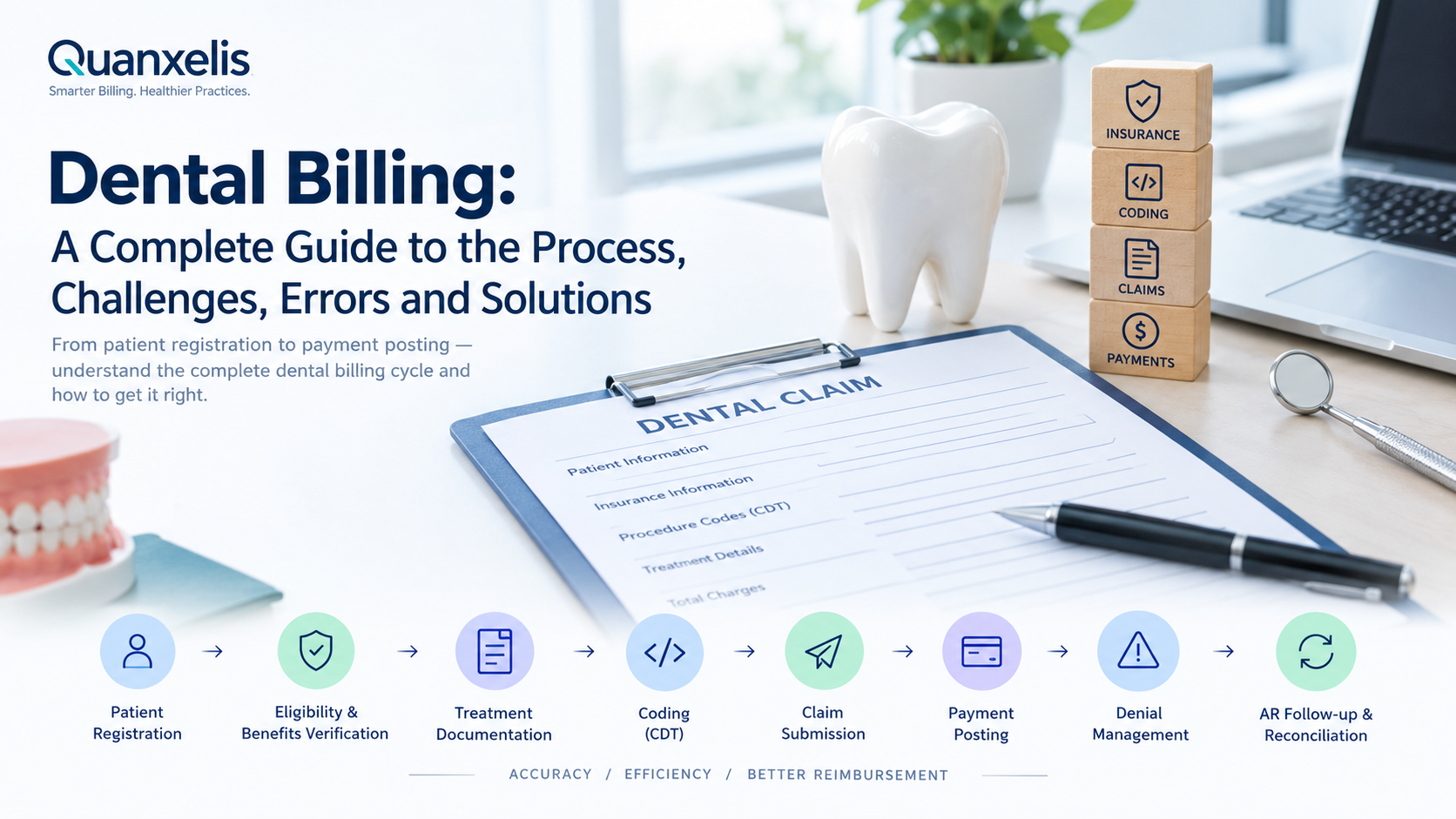

Dental billing is a critical part of running a financially healthy dental practice. It involves much more than submitting claims to insurance companies. The process begins when a patient provides demographic and insurance information and continues through eligibility verification, treatment documentation, coding, claim submission, payment posting, denial management and accounts receivable follow-up.
An effective dental billing process helps practices receive appropriate reimbursement, reduce claim denials, improve cash flow and give patients a clearer understanding of their financial responsibility.
Although dental billing shares similarities with medical billing, it has its own coding system, insurance rules, documentation requirements and reimbursement challenges. Understanding the complete dental billing cycle is essential for dental practices, billing teams and practice managers.
What Is Dental Billing?
Dental billing is the process of documenting dental services, assigning appropriate procedure codes, verifying insurance benefits, submitting claims, tracking claim status, posting payments, managing denials and collecting outstanding balances.
A typical dental billing cycle includes:
- Patient registration
- Insurance eligibility verification
- Benefits verification
- Treatment planning
- Clinical documentation
- Dental procedure coding
- Claim preparation
- Claim submission
- Claim tracking
- Payment posting
- Denial management
- Appeals
- Patient billing
- Accounts receivable follow-up
- Account reconciliation
- Financial reporting
The basic objective is simple:
Provide the service, document it correctly, code it accurately, submit a clean claim, receive appropriate reimbursement and resolve any remaining balance.
Dental Billing vs. Medical Billing
Dental billing and medical billing use many similar administrative concepts, but they are not the same.
Dental practices primarily use CDT (Current Dental Terminology) procedure codes maintained by the American Dental Association. Medical billing generally uses CPT and HCPCS procedure codes along with ICD-10-CM diagnosis codes.
Dental insurance also commonly includes:
- Annual benefit maximums
- Deductibles
- Waiting periods
- Frequency limitations
- Coverage percentages
- Exclusions
- Downgrades
- Missing tooth clauses
- Preauthorization requirements
For example, a dental plan may cover preventive services at a higher percentage than basic or major procedures.
This makes benefits verification particularly important before treatment.
1. Patient Registration
The dental billing process begins with accurate patient registration.
The practice should collect and verify:
- Full legal name
- Date of birth
- Address
- Phone number
- Email address
- Employer information, when applicable
- Insurance company
- Member ID
- Group number
- Subscriber name
- Subscriber date of birth
- Relationship to subscriber
- Secondary insurance information
- Guarantor or responsible-party information
Even a minor registration error can result in a rejected or denied claim.
For example, an incorrect date of birth or member ID can prevent the payer from matching the claim to the patient’s insurance record.
Best practice
Verify demographic and insurance information during registration and update it regularly.
2. Insurance Eligibility Verification
Insurance eligibility verification determines whether a patient’s dental coverage is active.
The billing team should verify:
- Coverage status
- Effective date
- Termination date, when applicable
- Insurance plan
- In-network or out-of-network status
- Deductible
- Deductible remaining
- Annual maximum
- Maximum remaining
- Coverage levels
- Waiting periods
- Frequency limitations
- Exclusions
- Missing tooth clauses
- Preauthorization requirements
- Coordination of benefits
An active insurance policy does not necessarily mean that every dental procedure is covered.
A patient may have active coverage but still have limitations on crowns, periodontal treatment, implants or other procedures.
3. Dental Benefits Verification
Eligibility verification answers one question:
Is the patient’s insurance active?
Benefits verification answers a more detailed question:
What does the patient’s plan cover?
The billing team should determine the patient’s benefits for the planned treatment.
| Benefit area | Information to verify |
| Preventive | Coverage percentage |
| Basic | Coverage percentage |
| Major | Coverage percentage |
| Deductible | Total and remaining amount |
| Annual maximum | Total and remaining amount |
| Frequency | Allowed frequency |
| Waiting period | Whether applicable |
| Orthodontics | Coverage and lifetime maximum |
| Missing tooth clause | Whether applicable |
| Preauthorization | Whether required |
| Downgrades | Whether applicable |
Accurate benefits verification helps the practice provide patients with more reliable treatment estimates.
4. Patient Financial Communication
Patients should receive clear information about their expected financial responsibility before treatment whenever possible.
This may include:
- Estimated insurance payment
- Estimated patient responsibility
- Deductible
- Coinsurance
- Noncovered services
- Annual maximum limitations
- Payment options
- Financing arrangements
Insurance estimates are not guarantees of payment. Final reimbursement depends on the patient’s plan and the payer’s adjudication of the claim.
Clear financial communication can reduce billing disputes and unexpected patient balances.
5. Treatment Planning and Documentation
The clinical team must document the patient’s condition and recommended treatment accurately.
Depending on the service, documentation may include:
- Clinical findings
- Treatment recommendations
- Tooth number
- Surface
- Quadrant
- Arch
- Periodontal findings
- Radiographs
- Intraoral photographs
- Treatment notes
- Dental history
- Medical history
- Consent documentation
- Preauthorization information
Billing staff should use the clinical documentation to support the claim.
They should not alter clinical information simply to obtain reimbursement.
6. Dental Coding
Dental procedures are generally reported using CDT codes.
CDT codes cover categories such as:
- Diagnostic services
- Preventive services
- Restorative procedures
- Endodontics
- Periodontics
- Prosthodontics
- Oral and maxillofacial surgery
- Orthodontics
- Adjunctive general services
The code selected should accurately represent the service performed and be supported by the clinical record.
Common coding problems
Claims may be delayed or denied because:
- The wrong procedure code was selected.
- The code does not match the documentation.
- Required tooth information is missing.
- Surface information is incorrect.
- The procedure conflicts with another submitted service.
- The payer requires additional documentation.
- A frequency limitation applies.
Coding accuracy is one of the most important components of dental billing.
7. Tooth Numbers and Surfaces
Many dental procedures require more detailed information than the procedure code alone.
Depending on the service, claims may require:
- Tooth number
- Surface
- Quadrant
- Arch
- Number of teeth
- Prosthetic information
- Date of service
An incorrect tooth number or surface can cause a claim to be rejected or denied.
Billing staff should compare claim information with the patient’s clinical documentation before submission.
8. Supporting Documentation
Certain dental procedures may require additional documentation.
Depending on the procedure and payer, this may include:
- X-rays
- Periodontal charts
- Clinical notes
- Intraoral photographs
- Treatment plans
- Narratives
- Previous treatment information
- Prosthetic information
- Referral documentation
- Preauthorization records
Documentation requirements vary by payer and procedure.
Best practice
Maintain payer-specific guidelines that identify common documentation and attachment requirements.
9. Dental Claim Preparation
Once the procedure has been documented and coded, the claim can be prepared.
A claim may include:
- Patient information
- Subscriber information
- Provider information
- Practice information
- Insurance information
- Date of service
- CDT procedure codes
- Tooth information
- Surface information, when required
- Fees
- Required claim details
- Supporting documentation
The claim should be reviewed before submission.
10. Claim Scrubbing
Claim scrubbing is the quality-control process performed before submission.
It helps identify errors that could result in rejection or unnecessary rework.
A claim review may check for:
- Missing patient information
- Incorrect member ID
- Incorrect payer
- Missing tooth number
- Missing surface
- Coding inconsistencies
- Duplicate procedures
- Incorrect dates
- Missing documentation
- Incorrect provider information
- Required attachments
The goal is to submit a clean claim the first time.
11. Electronic Claim Submission
Dental practices commonly submit claims electronically through a clearinghouse or other appropriate electronic claims channel.
Before submission, the billing team should verify:
- Correct payer destination
- Correct provider information
- Correct claim data
- Required attachments
- Successful transmission
Submitting a claim does not necessarily mean the payer has accepted it for processing.
A claim can be:
Created → Submitted → Rejected → Corrected → Resubmitted
Or:
Created → Submitted → Accepted → Adjudicated → Paid or Denied
Understanding this distinction is important for effective claim management.
12. Claim Acceptance vs. Claim Payment
Claim acceptance and claim payment are different stages.
Claim acceptance
The payer or clearinghouse has received the claim and accepted it into its processing system.
Claim adjudication
The payer evaluates the claim according to the patient’s benefits, coding, documentation, contractual requirements and other applicable rules.
A claim can be accepted electronically and still be denied later.
That is why claims must be monitored after submission.
13. Claim Status Tracking
Submitted claims should be actively tracked.
The billing team should know:
- When the claim was submitted
- Whether it was accepted
- Its current status
- Whether additional information was requested
- Whether payment was issued
- Whether it was denied
- Whether an appeal or correction is required
Submitting a claim and leaving it untouched can lead to unnecessary A/R aging.
14. Dental Claim Denial Management
Denials are one of the most common challenges in dental billing.
Eligibility denial
The patient’s coverage was inactive on the date of service.
Solution: Verify eligibility before treatment and follow the practice’s established verification process.
Incorrect patient information
Examples include:
- Incorrect name
- Incorrect date of birth
- Incorrect member ID
- Incorrect subscriber information
Solution: Verify demographic and insurance information before submitting the claim.
Incorrect procedure coding
The submitted code does not accurately represent the service provided.
Solution: Review the clinical documentation and correct the coding based on the actual service.
Missing tooth or surface information
The payer requires information that was not submitted.
Solution: Establish coding and claim-scrubbing checks for procedures requiring tooth or surface details.
Frequency limitation
The patient’s plan limits how often a particular service is covered.
Solution: Review the patient’s previous claims and benefit limitations before treatment when possible.
Annual maximum reached
The patient has exhausted the available annual benefit.
Solution: Check the remaining annual maximum during benefits verification.
Waiting period
The patient has coverage but has not completed an applicable waiting period.
Solution: Review waiting-period requirements before treatment.
Noncovered service
The patient’s plan excludes the procedure.
Solution: Identify exclusions during benefits verification and communicate expected patient responsibility.
Missing documentation
The payer requires supporting records.
Solution: Submit the required documentation and maintain organized clinical records.
Duplicate claim
The same service was submitted more than once.
Solution: Review claim history and use system controls to prevent duplicate submissions.
15. Dental Claim Appeals
A denied claim may be appealable, depending on the circumstances and payer requirements.
An appeal may include:
- Corrected claim
- Clinical documentation
- X-rays
- Narrative
- Treatment records
- Supporting evidence
- Payer-specific appeal forms
A strong appeal should directly address the reason for denial.
It should explain:
- What was denied.
- Why the payer denied it.
- Why the practice believes the decision should be reconsidered.
- What documentation supports the claim.
A generic request to “reconsider the claim” is generally less useful than a focused response addressing the specific denial reason.
16. Payment Posting
After a payer processes a claim, the payment must be posted accurately.
Payments may be received through:
- Electronic funds transfer
- Electronic remittance advice
- Paper checks
- Other payer payment methods
The billing team should record:
- Insurance payment
- Contractual adjustments, when applicable
- Patient responsibility
- Deductible
- Coinsurance
- Noncovered amounts
- Denials
- Other applicable adjustments
The account should then be reconciled.
17. Explanation of Benefits
The explanation of benefits, or EOB, shows how the payer processed a claim.
The billing team should compare the EOB with:
- The original claim
- Expected reimbursement
- Applicable contractual arrangements
- Patient responsibility
- Posted payment
Discrepancies should be investigated rather than automatically accepted.
18. Patient Billing
After insurance processing, any legitimate remaining patient balance may be billed to the patient.
A patient statement should clearly show:
- Date of service
- Procedure or service
- Amount charged
- Insurance payment
- Insurance adjustment
- Patient responsibility
- Previous balance
- Current balance
- Payment instructions
Clear statements can reduce confusion and improve collections.
19. Accounts Receivable Management
Accounts receivable, or A/R, represents money owed to the practice.
Dental A/R may include:
- Insurance balances
- Patient balances
- Aging claims
- Denied claims
- Underpaid claims
A/R should be monitored regularly.
Common aging categories include:
- 0-30 days
- 31-60 days
- 61-90 days
- 91-120 days
- More than 120 days
Older A/R generally requires more structured follow-up.
20. Insurance A/R Follow-Up
Insurance follow-up involves reviewing outstanding claims and contacting payers when necessary.
The billing team may investigate:
- Claim status
- Processing delays
- Missing information
- Documentation requests
- Denials
- Underpayments
- Incorrect payer routing
- Coordination-of-benefits issues
Every follow-up should be documented.
A useful tracking system records:
- Claim number
- Date submitted
- Follow-up date
- Payer response
- Reference number, when available
- Next action
- Next follow-up date
21. Patient A/R Follow-Up
Patient balances require a different approach from insurance A/R.
Practices may use:
- Patient statements
- Phone calls
- Online payment portals
- Payment links
- Payment plans
- Financial policies
- Other appropriate collection processes
The goal is to collect legitimate balances while maintaining a positive patient experience.
Common Dental Billing Challenges
1. Inaccurate Insurance Information
Patients may change insurance plans, employers or coverage.
Solution: Use standardized verification procedures and update insurance information regularly.
2. Complex Benefit Limitations
Dental plans can include frequency limits, annual maximums, exclusions, waiting periods and other restrictions.
Solution: Use structured benefit-verification templates and document the information obtained.
3. Coding Errors
Incorrect CDT coding can result in claim delays, denials or inaccurate reimbursement.
Solution: Train billing staff and conduct regular coding-quality reviews.
4. Missing Documentation
A payer may require documentation before processing a claim.
Solution: Use procedure-specific documentation checklists.
5. High Insurance A/R
Unworked claims can become aging receivables.
Solution: Establish A/R work queues with defined follow-up intervals and assigned responsibility.
6. Patient Confusion
Patients may not understand why insurance paid less than expected.
Solution: Explain estimates, benefit limitations and potential patient responsibility before treatment.
7. Underpayments
A payer may reimburse less than expected.
Solution: Compare payments with applicable contractual or expected reimbursement and investigate discrepancies.
8. Manual Billing Processes
Manual verification, claim entry, follow-up and payment posting can consume significant staff time.
Solution: Use practice-management systems, clearinghouse tools, automation and standardized workflows where appropriate.
Common Dental Billing Errors
Dental practices should watch for:
- Incorrect patient demographics
- Incorrect insurance information
- Incorrect subscriber information
- Incorrect CDT coding
- Missing tooth numbers
- Incorrect tooth numbers
- Missing surface information
- Incorrect dates of service
- Duplicate claims
- Missing documentation
- Incorrect payer selection
- Missing attachments
- Failure to verify benefits
- Failure to check annual maximums
- Failure to review frequency limitations
- Failure to identify waiting periods
- Incorrect patient responsibility
- Failure to follow up on claims
- Incorrect payment posting
- Failure to appeal appropriate denials
- Poor A/R tracking
- Unresolved aged balances
- Inconsistent clinical documentation
- Poor communication between clinical and billing teams
How to Prevent Dental Billing Errors
A strong dental billing operation should have checkpoints throughout the revenue cycle.
Before the appointment
- Verify demographics.
- Verify insurance.
- Confirm eligibility.
- Review benefits.
- Identify limitations.
- Determine whether preauthorization is required.
During treatment
- Document services accurately.
- Record the correct tooth information.
- Record surfaces when applicable.
- Maintain required clinical records.
Before claim submission
- Verify CDT coding.
- Review patient information.
- Confirm the payer.
- Check required attachments.
- Complete claim scrubbing.
After submission
- Confirm claim acceptance.
- Track claim status.
- Work rejected claims.
- Monitor aging.
After adjudication
- Post payment.
- Review adjustments.
- Identify underpayments.
- Work denials.
- Bill legitimate patient balances.
- Continue A/R follow-up.
Dental Billing Key Performance Indicators
Dental practices should monitor billing performance through measurable key performance indicators, or KPIs.
Clean Claim Rate
The percentage of claims submitted without errors that cause avoidable rejection or rework.
Claim Denial Rate
The percentage of submitted claims that are denied.
Days in A/R
Measures how long outstanding receivables remain unpaid.
A/R Over 90 Days
Shows the amount of receivables that have become significantly aged.
Collection Rate
Measures how effectively the practice collects revenue.
Net Collection Rate
Measures collections after applicable adjustments and provides a clearer picture of collection performance.
Insurance A/R
The amount currently owed by insurance companies.
Patient A/R
The amount currently owed by patients.
Payment Posting Accuracy
Measures whether payments and adjustments are posted correctly.
Technology and Automation in Dental Billing
Technology can improve dental billing by reducing repetitive administrative work and helping staff identify issues earlier.
Potential automation opportunities include:
- Automated eligibility checks
- Insurance verification workflows
- Claim scrubbing
- Claim-status tracking
- Automated work queues
- Denial categorization
- A/R aging alerts
- Payment posting assistance
- Patient statement automation
- Payment reminders
- Reporting dashboards
- Document management
- Workflow notifications
Automation should support trained billing staff rather than eliminate appropriate human review.
Complex claims, unusual clinical circumstances, documentation issues and payer-specific requirements may still require experienced staff.
AI in Dental Billing
Artificial intelligence can also support selected dental billing workflows.
Potential applications include:
Denial Prediction
AI systems can analyze historical claim information and identify patterns associated with potential denials.
Documentation Review
AI-assisted systems may flag potentially missing information before submission.
Claim Quality Checks
Technology can identify inconsistencies in available clinical and billing information.
A/R Prioritization
AI can help prioritize accounts based on factors such as:
- Balance
- Age
- Denial reason
- Payer behavior
- Required action
- Collection probability
Follow-Up Assistance
Automated systems can organize payer follow-up tasks and reminders.
Patient Communication
Technology can assist with appropriate billing reminders and other routine communication.
AI should be implemented with appropriate privacy, security, compliance and human oversight.
HIPAA and Dental Billing Compliance
Dental practices handle protected health information and must take appropriate steps to protect patient data.
Billing operations should consider:
- HIPAA privacy requirements
- HIPAA security requirements
- Access controls
- Secure communication
- Workforce training
- Business associate requirements, when applicable
- Secure data storage
- Audit controls
- Minimum-necessary access
- Appropriate handling of patient information
Dental practices should carefully evaluate third-party billing companies and technology vendors that handle protected health information.
Outsourcing Dental Billing
Some practices manage billing internally, while others outsource part or all of their billing operations.
Outsourced services may include:
- Eligibility verification
- Benefits verification
- Dental coding support
- Claim submission
- Claim tracking
- Denial management
- Payment posting
- A/R follow-up
- Patient billing support
- Reporting
The right approach depends on the practice’s size, staffing, claim volume, payer mix, specialty, technology and internal capabilities.
A good billing partner should provide visibility into the revenue cycle rather than simply submit claims.
Practice leaders should be able to see:
- What was billed
- What was paid
- What was denied
- What remains outstanding
- Why claims are aging
- What actions are being taken
- Where revenue leakage may be occurring
Building an Efficient Dental Billing Department
A successful dental billing operation requires clear responsibilities.
Front Desk
Responsible for:
- Patient registration
- Demographic updates
- Insurance information
- Scheduling
- Financial communication
Clinical Team
Responsible for:
- Accurate documentation
- Treatment records
- Tooth and surface information
- Clinical support for claims
Billing Team
Responsible for:
- Coding
- Claim preparation
- Claim submission
- Claim tracking
- Denial management
- Payment posting
- A/R follow-up
Practice Management
Responsible for:
- Financial performance
- KPIs
- Compliance
- Staff performance
- Process improvement
- Payer issues
- Technology strategy
The most effective practices connect these functions rather than treating billing as a separate activity.
The Complete Dental Billing Workflow
A well-structured dental billing process can follow this sequence:
Patient registration
↓
Insurance eligibility verification
↓
Benefits verification
↓
Treatment planning
↓
Clinical documentation
↓
CDT coding
↓
Claim quality review
↓
Electronic claim submission
↓
Claim acceptance monitoring
↓
Claim adjudication
↓
Payment posting
↓
Denial and underpayment management
↓
Patient billing
↓
A/R follow-up
↓
Appeals
↓
Account reconciliation
↓
Reporting and process improvement
This approach turns dental billing into a complete revenue cycle rather than simply a claim-submission function.
Final Thoughts
Dental billing is a complex administrative process that requires coordination among the front desk, clinical team, billing staff, patients, insurance companies and technology systems.
Many revenue problems begin before a claim is ever submitted. An incorrect insurance number can lead to a rejection. A missed frequency limitation can create an unexpected patient balance. An incorrect CDT code can result in a denial. Missing documentation can delay reimbursement. An unworked denial can become aging A/R, while inaccurate payment posting can affect financial reporting.
The solution is not simply to submit more claims.
A strong dental billing operation combines:
Accurate registration + insurance verification + benefits verification + accurate coding + complete documentation + clean claim submission + claim tracking + denial management + accurate payment posting + disciplined A/R follow-up + clear patient communication + appropriate technology.
When these processes work together, dental practices can reduce avoidable billing errors, improve collections, manage A/R more effectively and create a more predictable revenue cycle.
Dental billing is ultimately about more than getting claims out the door. It is about helping the practice receive the revenue it has legitimately earned — accurately, efficiently and consistently.