

Category: Medical Billing & Coding
Author: QuanXelis
Target Audience: Behavioral Health Providers, Mental Health Clinics, and Healthcare Administrators
Introduction
Behavioral health services play an essential role in the U.S. healthcare system. However, accurate coding and billing remain important operational challenges for many behavioral health practices. Incomplete documentation, incorrect diagnosis coding, inappropriate procedure code selection, and payer-specific billing requirements can lead to claim denials, payment delays, and compliance concerns.
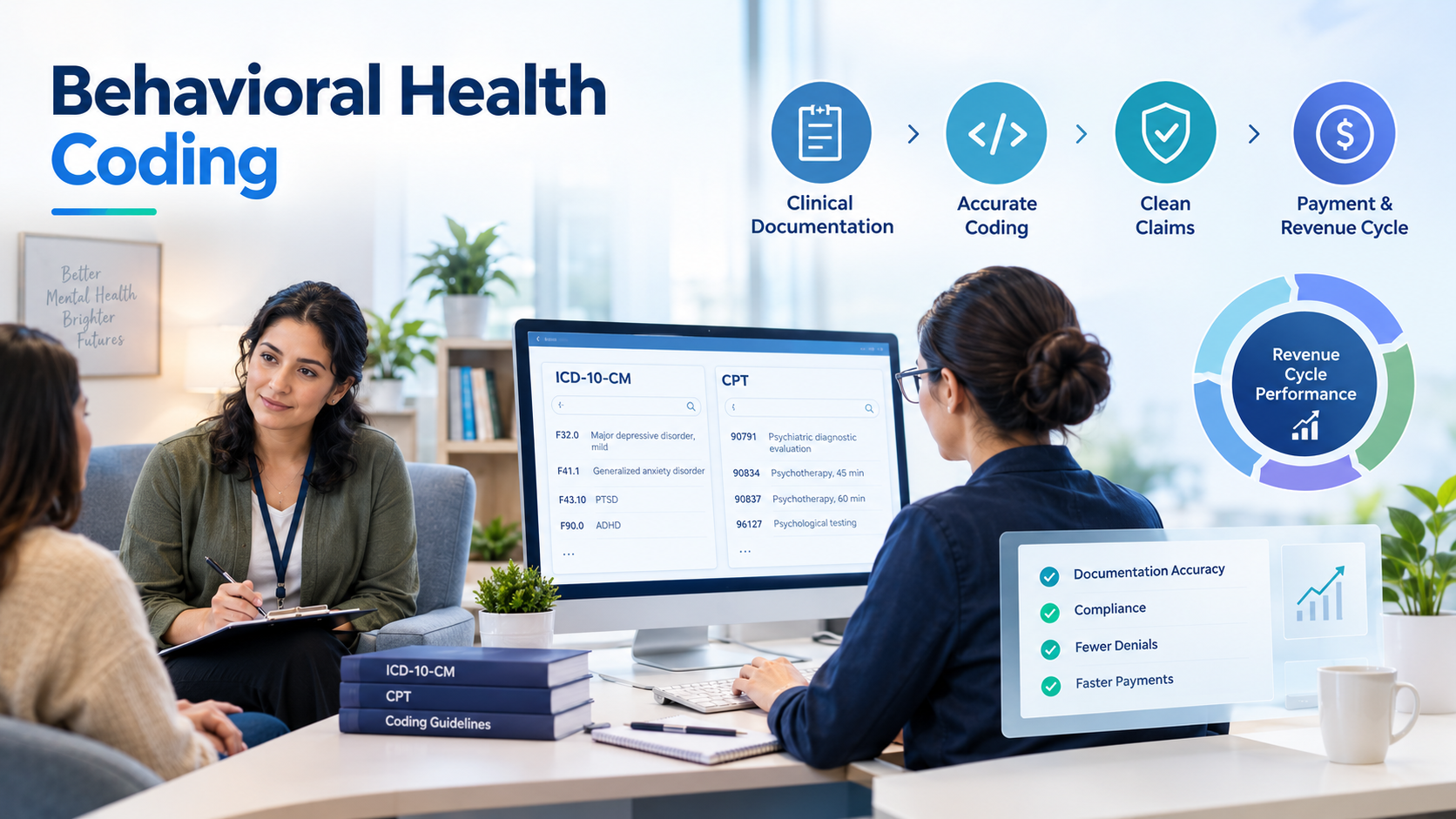
Behavioral health coding involves translating documented clinical services and diagnoses into appropriate medical codes for insurance claims. A consistent coding process helps practices maintain accurate records, support medical necessity, and improve revenue cycle performance.
Understanding Behavioral Health Coding
Behavioral health coding primarily involves two code sets: ICD-10-CM for diagnoses and CPT for professional services and procedures. The appropriate codes depend on the service performed, the provider’s documentation, the provider’s qualifications, and applicable payer policies.
ICD-10-CM codes may represent documented mental, behavioral, and neurodevelopmental disorders, while CPT codes may describe services such as psychiatric diagnostic evaluations, psychotherapy, and other eligible behavioral health services.
Selecting a code based only on a patient’s symptoms or the general nature of a visit is not sufficient. Coding professionals must review the documentation and follow the applicable official coding guidelines.
Common Challenges in Behavioral Health Coding
1. Incomplete Clinical Documentation
Documentation is the foundation of accurate coding. Missing diagnoses, unclear treatment goals, insufficient session details, or incomplete records can make it difficult to determine whether a claim is appropriately supported.
Providers should document the service delivered, relevant clinical findings, treatment objectives, and other information required by applicable coding and payer rules. Documentation should accurately reflect the service rather than being altered simply to support reimbursement.
2. Incorrect CPT Code Selection
Behavioral health services may involve different CPT codes depending on the type of service and applicable requirements. For example, psychotherapy services and psychiatric diagnostic evaluations are not interchangeable.
Coders should verify the service performed, documented time when relevant, provider eligibility, and payer-specific requirements before assigning a CPT code. Time-based services require particular attention to the applicable code descriptor and reporting rules.
3. ICD-10-CM Diagnosis Coding Errors
Diagnosis coding requires the selection of codes supported by the treating provider’s documentation. Common problems include choosing an unspecified diagnosis when greater specificity is documented, reporting unsupported diagnoses, or overlooking applicable coding instructions.
Using the current ICD-10-CM code set and official guidelines helps reduce these errors. For U.S. healthcare claims, the applicable code year must be determined by the date of service.
4. Claim Denials and Payer Requirements
Behavioral health claims may be denied because of incorrect coding, missing information, authorization issues, eligibility problems, or failure to meet payer-specific billing requirements.
An effective denial-management process should identify the actual reason for each denial, correct valid errors, and address recurring issues. Repeatedly resubmitting a claim without resolving its underlying problem may lead to further delays.
Best Practices for Accurate Behavioral Health Coding
Behavioral health practices can strengthen their billing operations through a structured coding and compliance process:
- Verify documentation: Ensure that the clinical record supports the diagnosis and service reported.
- Use current code sets: Check the applicable ICD-10-CM and CPT resources for the date of service.
- Confirm payer requirements: Review coverage policies, authorization requirements, provider eligibility, and billing instructions.
- Conduct claim reviews: Identify coding inconsistencies and missing information before claim submission.
- Monitor denials: Track recurring denial reasons and implement corrective actions.
- Provide regular training: Keep coding and billing staff informed about relevant coding updates and compliance requirements.
These practices can improve claim quality and reduce avoidable billing errors, although reimbursement ultimately depends on the applicable coverage and payment rules.
The Role of Medical Billing and Coding Specialists
Behavioral health billing requires attention to both coding accuracy and administrative requirements. Qualified billing and coding specialists help practices review documentation, select supported codes, submit claims, investigate denials, and maintain consistent billing workflows.
They also help identify recurring operational issues that may affect reimbursement. Effective coordination between providers, coding professionals, and billing teams is particularly important when clarification is needed before a claim can be submitted accurately.
How QuanXelis Supports Behavioral Health Practices
At QuanXelis, we understand that accurate medical billing and coding are important components of a well-managed healthcare practice. Our healthcare support services focus on improving billing workflows, supporting coding accuracy, identifying claim issues, and helping practices manage revenue cycle operations more efficiently.
By emphasizing documentation quality, coding compliance, and systematic claim follow-up, we aim to help healthcare organizations reduce avoidable administrative challenges and maintain more consistent billing processes.
Conclusion
Accurate behavioral health coding requires more than selecting a diagnosis or procedure code. It involves reviewing clinical documentation, understanding applicable coding guidelines, meeting payer requirements, and maintaining a reliable claim review process.
Behavioral health practices that invest in coding accuracy, staff education, and ongoing claim monitoring can strengthen compliance and improve their revenue cycle operations.
Looking to improve your behavioral health billing process? Connect with QuanXelis to explore medical billing, coding, and revenue cycle support tailored to your practice’s operational needs.
Disclaimer: This article is for educational purposes only and does not constitute legal, clinical, or payer-specific billing advice. Always verify code selection against current official coding resources and applicable payer policies.