
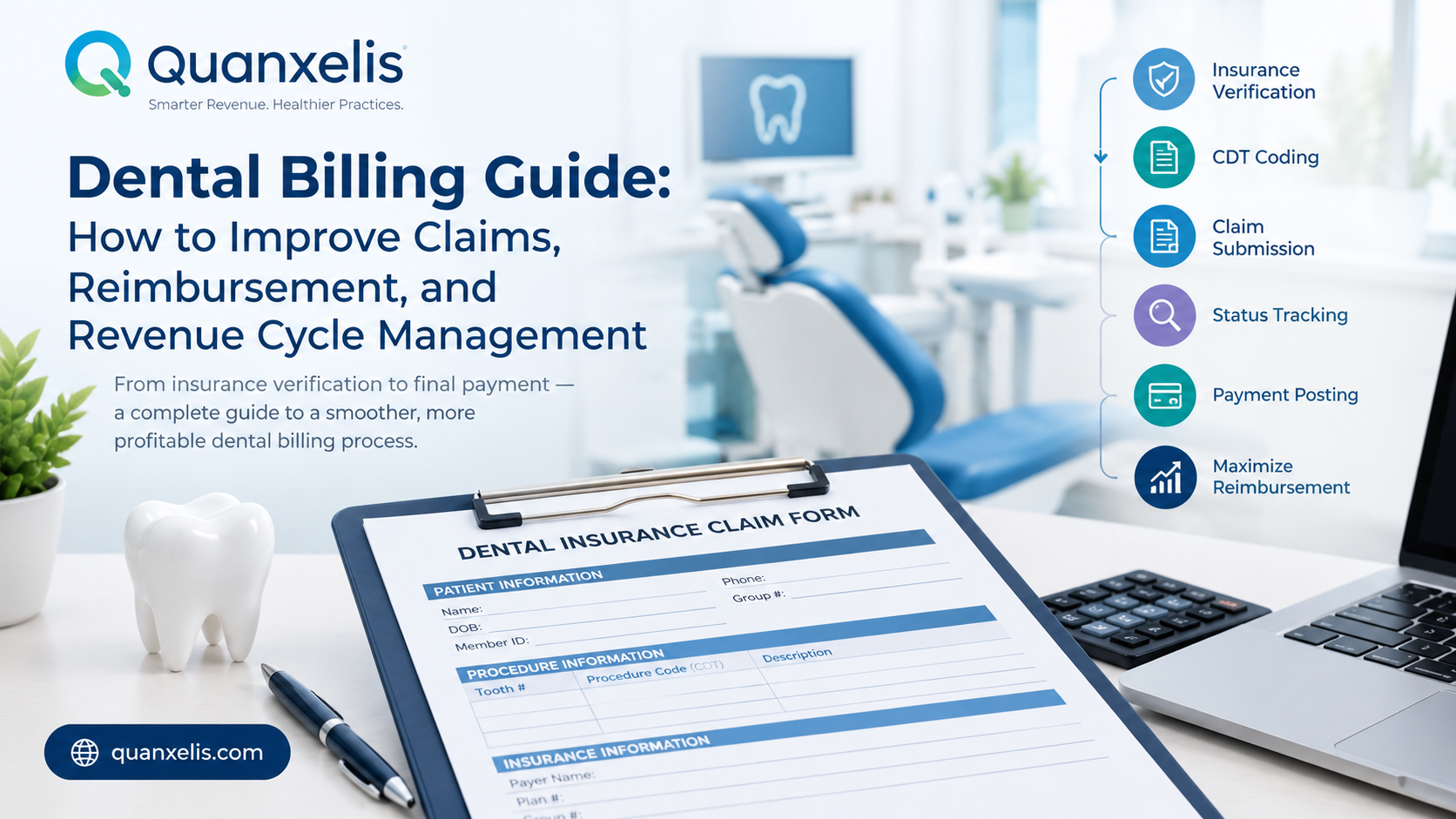

Dental practices do more than provide clinical care. They also manage insurance verification, procedure coding, claim submission, payment posting, patient balances, claim follow-up, and accounts receivable. When any part of this process breaks down, payments can be delayed and revenue can be left uncollected.
A strong dental billing process connects clinical documentation with accurate coding, complete claims, payer requirements, and consistent follow-up.
This guide explains the dental billing process from start to finish and highlights the areas that can have the biggest impact on reimbursement and cash flow.
What Is Dental Billing?
Dental billing is the process of converting dental services provided to a patient into accurate insurance claims and patient charges, then following those claims through payment or resolution.
The process typically includes:
- Patient and insurance information collection
- Insurance eligibility and benefits verification
- Treatment plan and financial review
- CDT procedure coding
- Documentation and claim preparation
- Dental claim submission
- Claim status tracking
- Denial management and appeals
- Insurance payment posting
- Patient billing and collections
- Accounts receivable follow-up
Dental billing is closely connected to dental coding. Coding identifies the procedure performed, while billing communicates that information to the payer and tracks the financial outcome.
The ADA maintains the CDT Code, which provides standardized terminology for documenting and reporting dental procedures. The code used on a claim should correspond to the procedure actually performed and documented.
Why Accurate Dental Billing Matters
A dental practice can provide excellent clinical care and still experience revenue problems if its billing process is inconsistent.
Common problems include:
- Incorrect or outdated procedure codes
- Incomplete patient information
- Eligibility issues
- Missing documentation
- Incorrect insurance details
- Coordination of benefits problems
- Missed filing deadlines
- Incorrect claim attachments
- Claim denials
- Underpayments
- Unresolved patient balances
- Aging accounts receivable
The result can be delayed reimbursement, additional administrative work, and unnecessary pressure on the practice team.
Effective dental revenue cycle management is therefore not simply about submitting claims. It is about creating a process that follows the claim from the patient’s appointment through final payment.
The Dental Billing Workflow
A well-managed dental billing cycle generally follows these steps:
Patient Registration → Eligibility Verification → Treatment & Documentation → CDT Coding → Claim Preparation → Claim Submission → Claim Adjudication → Payment Posting → Denial/Appeal Follow-Up → Patient Balance → A/R Resolution
Each step matters because an error early in the process can create problems later.
1. Verify Dental Insurance Eligibility
Insurance verification should happen before treatment whenever possible.
The billing team should confirm information such as:
- Patient eligibility
- Member ID
- Group number
- Subscriber information
- Effective and termination dates
- Annual maximum
- Deductible
- Remaining benefits
- Coverage percentages
- Waiting periods
- Frequency limitations
- Exclusions and limitations
- Missing tooth clauses, when applicable
- Coordination of benefits
- Network participation
- Preauthorization or predetermination requirements
Insurance information should also be reviewed when necessary around the date of service because eligibility and remaining benefits can change.
The ADA emphasizes that preauthorization and predetermination are different processes and that benefit estimates are not guarantees of payment. Actual coverage can depend on the patient’s eligibility and available benefits at the time of service.
Why Eligibility Verification Matters
A claim can be coded correctly and still result in an unexpected patient balance if the patient’s coverage, frequency limitations, annual maximum, or other plan provisions were not properly understood.
A good verification process helps the dental office set more realistic expectations before treatment begins.
2. Understand CDT Coding
Dental procedures are reported using CDT — Code on Dental Procedures and Nomenclature.
Accurate coding starts with the clinical documentation.
The basic principle is simple:
Code the procedure that was actually performed and documented.
The ADA recommends reviewing the complete code nomenclature and descriptor rather than relying on shortened descriptions. A procedure code by itself also does not guarantee that the patient’s dental plan will cover or reimburse the service.
Common Dental Coding Areas
Dental billing teams may work with procedures involving:
- Diagnostic services
- Preventive services
- Restorative procedures
- Endodontics
- Periodontics
- Prosthodontics
- Maxillofacial prosthodontics
- Oral and maxillofacial surgery
- Orthodontic procedures
- Adjunctive general services
The correct code should reflect the actual service, clinical circumstances, and documentation.
Coding Errors to Avoid
Common coding problems include:
- Selecting a code that does not match the procedure
- Using an incorrect code version
- Incomplete documentation
- Missing required narratives
- Incorrect tooth or surface information
- Incorrect dates
- Improper use of procedure combinations
- Failing to review complex treatment before submission
The ADA specifically recommends reviewing coding before claims are submitted because coding errors can result in rejections, additional information requests, or denials.
3. Prepare a Clean Dental Claim
A clean claim contains accurate information and the documentation required by the payer.
Depending on the procedure and payer, a claim may require supporting information such as:
- Clinical notes
- Radiographs
- Periodontal charting
- Intraoral photographs
- Treatment narratives
- Tooth and surface information
- Supporting reports
- Preauthorization or predetermination information
The objective is to give the payer enough accurate information to process the claim without unnecessary requests for clarification.
For procedures reported with a “by report” code, the ADA notes that an appropriate narrative should explain the service and relevant clinical circumstances.
What Makes a Dental Claim “Clean”?
A clean claim generally has:
- Correct patient information
- Correct subscriber information
- Correct payer information
- Accurate provider information
- Correct CDT code
- Correct date of service
- Correct tooth/surface information where applicable
- Appropriate fee
- Required documentation
- Appropriate claim attachments
- Correct coordination of benefits information
The more accurate the claim is before submission, the less rework the billing team may face later.
4. Submit Claims Promptly
Timely claim submission is another important part of dental billing.
Delaying claims can create unnecessary risk, especially when payers have filing deadlines.
Dental offices should establish a consistent process for:
- Reviewing completed procedures
- Confirming documentation
- Coding the service
- Preparing the claim
- Attaching required documentation
- Submitting electronically when appropriate
- Confirming claim acceptance
- Tracking the claim until adjudication
Submission is not the end of the billing process.
It is only the beginning of claim follow-up.
5. Track Dental Claims After Submission
One of the biggest weaknesses in many billing workflows is submitting claims without consistently monitoring them afterward.
A strong claim-tracking process should identify:
- Claims submitted
- Claims accepted
- Claims rejected
- Claims pending
- Claims paid
- Claims partially paid
- Claims denied
- Claims requiring additional documentation
- Claims requiring appeal
- Claims approaching timely filing or appeal deadlines
Unpaid claims should not simply remain in an aging report without action.
Each unresolved claim should have a reason, status, next action, and follow-up date.
6. Manage Dental Claim Denials
Claim denials can affect both cash flow and staff productivity.
Common reasons include:
- Incorrect coding
- Missing information
- Incomplete documentation
- Eligibility problems
- Benefit limitations
- Frequency limitations
- Coordination of benefits issues
- Missing narratives
- Incorrect patient information
- Payer-specific requirements
- Bundling or downcoding issues
- Claims submitted after filing deadlines
The ADA identifies several payer-related issues that can affect dental claims, including bundling, downcoding, coordination of benefits, documentation, and provider contract requirements.
How to Handle a Denied Dental Claim
A practical denial workflow is:
1. Identify the denial reason
Determine exactly why the payer did not process or pay the claim.
2. Review the original claim
Check patient information, CDT coding, dates, provider information, fees, and attachments.
3. Compare the claim with documentation
Make sure the submitted information accurately represents the clinical record.
4. Correct errors when necessary
If the claim contains an error, submit a corrected claim according to payer requirements.
5. Appeal when appropriate
If the original claim was accurate and the denial can be challenged, prepare an appropriate appeal with supporting documentation.
6. Track the outcome
Do not consider the claim resolved until payment, correction, or final payer determination is documented.
The ADA recommends reviewing rejected or denied claims to determine whether coding errors exist and correcting the claim when appropriate; when there is no coding error and grounds exist, an appeal may be appropriate.
7. Payment Posting and Reconciliation
Getting an insurance payment does not mean the billing process is finished.
Payments should be posted accurately against the corresponding claims.
The billing team should review:
- Insurance payment
- Contractual adjustments
- Deductibles
- Coinsurance
- Copayments
- Patient responsibility
- Denied procedures
- Partial payments
- Outstanding balances
The Explanation of Benefits (EOB) or electronic remittance information should be compared with the practice’s records.
Any unexpected difference should be investigated rather than automatically written off.
8. Patient Billing and Collections
Dental insurance usually does not pay the entire charge.
Patient responsibility may include:
- Deductible
- Copayment
- Coinsurance
- Non-covered services
- Amounts above plan limitations
- Services subject to frequency restrictions
- Remaining balances after insurance payment
Clear communication is important.
Patients should understand their estimated financial responsibility before treatment whenever possible.
However, offices should be careful not to present an insurance estimate as a guaranteed payment. Dental benefit plans determine coverage according to their specific provisions.
9. Dental Accounts Receivable Management
Accounts receivable, or A/R, represents money that remains outstanding.
A strong A/R process separates balances into categories such as:
- Current insurance A/R
- Aging insurance A/R
- Denied claims
- Patient A/R
- Credit balances
- High-value outstanding claims
The goal is not simply to reduce the A/R number.
The goal is to identify why money remains outstanding and what action is required to collect it.
Useful A/R monitoring metrics can include:
- Total A/R
- A/R by aging bucket
- Insurance A/R
- Patient A/R
- Days in A/R
- Denial rate
- Clean claim rate
- Collection rate
- Outstanding claims
- Average reimbursement time
Revenue cycle management in dentistry covers the financial journey from scheduling through final payment, making A/R and claim follow-up critical components of overall practice performance.
Common Dental Billing Mistakes
Some billing problems repeatedly appear across dental practices.
1. Skipping Eligibility Verification
Submitting claims without understanding the patient’s current coverage can create avoidable problems.
2. Choosing the Wrong CDT Code
Coding should accurately represent the service performed and documented.
3. Missing Documentation
Some procedures require additional clinical information or narratives to support the claim.
4. Ignoring Payer-Specific Requirements
Different dental plans can have different requirements, limitations, and processing policies.
5. Not Following Up on Unpaid Claims
A claim that was submitted but never monitored can remain unpaid for weeks or months.
6. Treating Every Denial the Same
Denial management works best when the root cause is identified before correcting or appealing the claim.
7. Poor Payment Posting
Incorrect posting can make it difficult to understand the actual outstanding balance.
8. Allowing A/R to Age Without Action
Old A/R requires structured follow-up and escalation.
How Technology Can Improve Dental Billing
Modern dental practices can use practice management systems, electronic claim submission, eligibility tools, clearinghouses, reporting dashboards, and automation to reduce manual work.
Technology can help with:
- Eligibility verification
- Electronic claim submission
- Claim status tracking
- Automated claim alerts
- Payment posting
- A/R reporting
- Denial tracking
- Patient statements
- Data reporting
However, technology does not replace the need for accurate clinical documentation, correct coding, payer knowledge, and human review.
The strongest billing workflow combines technology with knowledgeable billing and coding staff.
Dental Billing Compliance: Why Accuracy Matters
Dental billing is not simply an administrative task.
Claims should accurately represent services provided and documented.
The ADA notes that the applicable CDT code should correspond to the version effective on the date of service, and dental benefit coverage is determined by the patient’s specific plan rather than simply by the existence of a CDT code.
This distinction is important:
A valid dental code does not automatically mean the insurance plan covers the procedure.
The billing team must understand both:
Coding: What procedure was performed?
Coverage: What does the patient’s plan allow or reimburse?
These are related, but they are not the same thing.
Dental Billing Best Practices Checklist
Before considering a dental billing workflow complete, practices should ask:
- Is patient information accurate?
- Has eligibility been verified?
- Are benefits and limitations understood?
- Is the correct CDT code being used?
- Does the documentation support the code?
- Are tooth and surface details correct?
- Are required narratives included?
- Are required attachments included?
- Was the claim submitted on time?
- Was claim acceptance confirmed?
- Are unpaid claims being tracked?
- Are denials categorized by root cause?
- Are corrected claims submitted when appropriate?
- Are valid appeals being pursued?
- Are payments posted accurately?
- Are patient balances clearly communicated?
- Is aging A/R reviewed regularly?
- Are recurring billing errors being analyzed and corrected?
Final Thoughts
Effective dental billing is much more than sending claims to insurance companies.
It is a complete revenue cycle that begins with accurate patient and insurance information and continues through coding, documentation, claim submission, payer follow-up, payment posting, denial management, patient billing, and A/R resolution.
The practices that build a structured billing workflow can reduce avoidable errors, improve claim visibility, strengthen collections, and give their teams more time to focus on patient care.
For dental practices, the goal should not simply be “submit more claims.”
The goal should be:
Submit accurate claims, get them processed correctly, resolve problems quickly, and collect every legitimate dollar owed to the practice.