
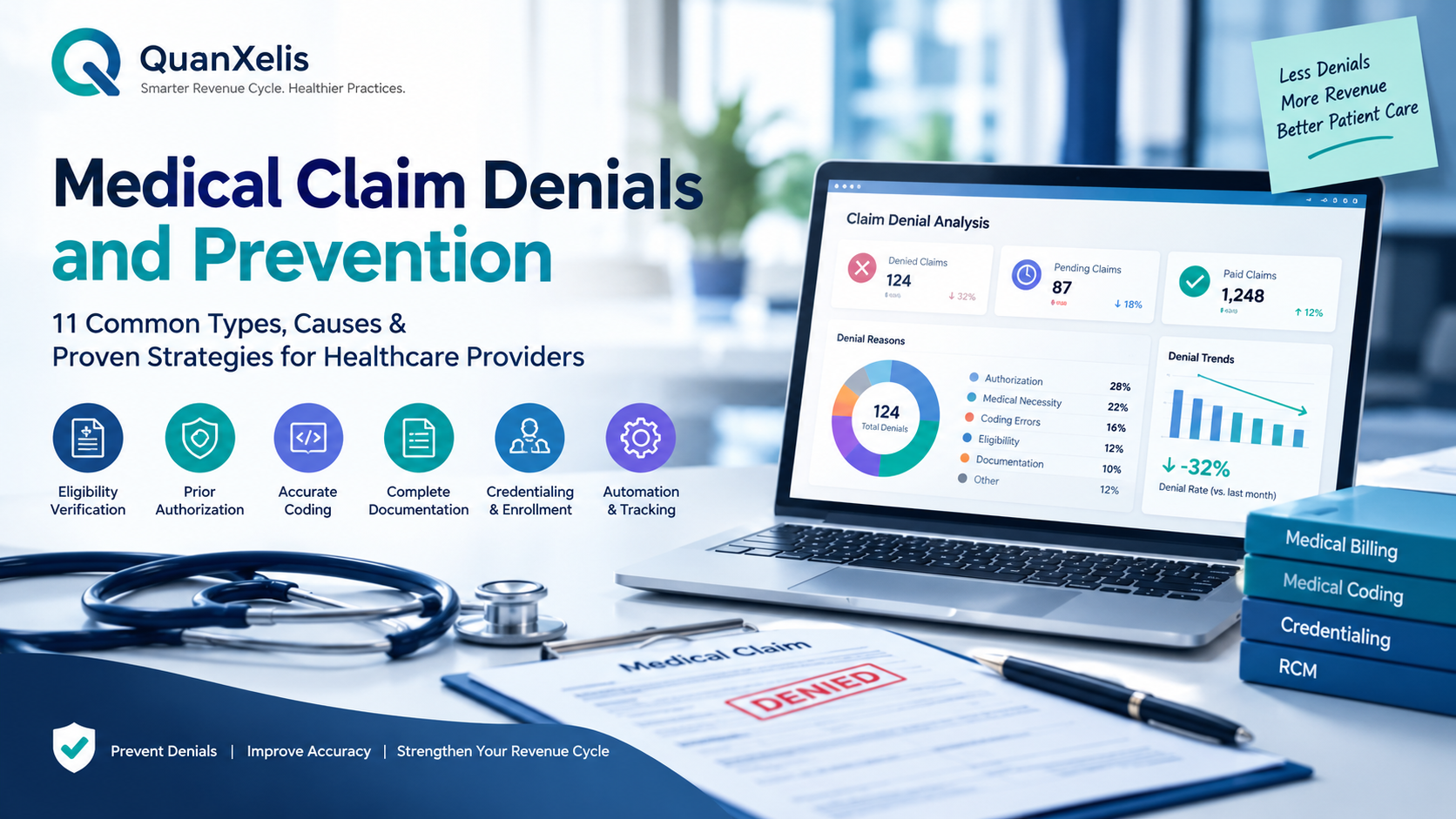

Medical claim denials are a major challenge for healthcare providers across the United States. When an insurance payer rejects a claim or refuses payment for a service, providers may face reimbursement delays, additional administrative work, increased accounts receivable (A/R), and potential revenue loss.
For physician practices, behavioral health providers, specialists, and other healthcare organizations, understanding medical claim denial reasons is an essential part of effective revenue cycle management (RCM).
The good news is that many preventable denials can be reduced through accurate medical coding, insurance eligibility verification, provider credentialing, complete documentation, and consistent claim monitoring.
In this guide, we explain 11 common types of medical claim denials, their causes, and practical strategies healthcare practices can use to prevent them.
What Are Medical Claim Denials?
A medical claim denial occurs when an insurance payer determines that a submitted claim, or a particular service on that claim, does not qualify for payment under the applicable coverage, billing, or reimbursement rules.
A denial may occur because of incorrect patient information, missing authorization, coding errors, insufficient documentation, or a service that is not covered by the patient’s plan.
It is important to distinguish between a claim rejection and a claim denial. A rejection generally occurs when a claim fails initial submission or formatting edits and must be corrected before adjudication. A denial occurs when a payer processes a claim and determines that payment cannot be made, in whole or in part.
Understanding this difference helps billing teams select the appropriate corrective action.
11 Common Types of Medical Claim Denials and Their Prevention
1. Eligibility and Insurance Coverage Denials
Eligibility denials occur when a patient is not eligible for the billed service under the insurance coverage applicable on the date of service.
Common reasons:
- Insurance coverage has expired or terminated.
- Incorrect member ID or group number.
- Patient information does not match payer records.
- The service is excluded from the patient’s benefits.
- The wrong insurance plan is billed.
How to prevent them:
Verify insurance eligibility before each appointment whenever practical. Confirm the patient’s name, date of birth, member ID, coverage dates, plan details, and relevant benefit limitations. Update registration information when a patient’s insurance changes.
Eligibility verification should also identify coordination-of-benefits issues and whether another payer may be primary.
2. Prior Authorization and Referral Denials
Some health plans require prior authorization or a referral before specific services can be covered. Missing or invalid authorization can result in a denial even when the service was performed appropriately.
Common reasons:
- Authorization was never obtained.
- The authorization expired before the service date.
- The approved service does not match the service billed.
- The authorization covers a different provider or location.
- A required referral is missing.
How to prevent them:
Check payer-specific authorization and referral requirements before providing the service. Track authorization numbers, approved service codes when applicable, validity dates, visit limits, and authorized locations.
Create a follow-up process for pending requests and verify that the approval matches the actual service. Remember that authorization does not guarantee payment; eligibility, coverage, documentation, and other payer requirements still apply.
3. Medical Necessity Denials
Medical necessity denials occur when the payer determines that the submitted documentation does not establish that the service meets its applicable medical necessity criteria.
Common reasons:
- Documentation does not support the service performed.
- The diagnosis does not support the billed procedure under payer policy.
- Required clinical records are missing.
- Medical necessity criteria or coverage policies were not met.
- The treatment plan lacks sufficient supporting detail.
How to prevent them:
Ensure that clinical documentation accurately reflects the patient’s condition, assessment, treatment plan, and services provided. Review applicable payer medical policies and coverage requirements before submitting claims for services with specific medical necessity criteria.
If a denial occurs, compare the payer’s stated reason with the medical record and applicable policy. Submit supporting records or an appeal when justified.
4. Medical Coding Errors
Incorrect medical coding can cause claim denials, payment delays, and compliance concerns. Accurate coding requires alignment between the medical record, the service provided, and applicable coding guidelines.
Common reasons:
- Incorrect CPT or HCPCS procedure codes.
- Invalid or unsupported ICD-10-CM diagnosis codes.
- Incorrect modifiers.
- Incorrect units or place-of-service codes.
- Unbundling or other coding errors.
- Coding that does not match the documented service.
How to prevent them:
Use the current applicable code sets and official coding guidelines. Verify that CPT, HCPCS, and ICD-10-CM codes accurately represent the documented services and diagnoses.
Review modifier requirements, code combinations, units, and payer-specific edits before claim submission. Use qualified medical coding professionals and conduct regular audits to identify recurring errors.
Automated coding checks can flag potential inconsistencies, but qualified staff should review complex cases and resolve documentation questions appropriately.
5. Incomplete or Insufficient Documentation Denials
Payers may deny claims when the medical record does not contain sufficient information to support the billed service or establish compliance with applicable payment requirements.
Common reasons:
- Missing progress notes or treatment records.
- Incomplete assessment or treatment plans.
- Missing required signatures or dates.
- Inadequate documentation of the service performed.
- Failure to respond to a request for medical records.
How to prevent them:
Establish documentation standards appropriate to the specialty and service. Confirm that records are complete, legible, dated, and authenticated as required.
Maintain a process for responding to additional documentation requests within the applicable deadlines. Ensure that records submitted to the payer support the actual services billed and are consistent with the original medical record.
6. Provider Credentialing and Enrollment Denials
Credentialing and enrollment issues can prevent providers from receiving payment from insurers, particularly when a provider is not properly enrolled or the claim contains incorrect provider identifiers.
Common reasons:
- Provider enrollment is incomplete.
- The provider is not enrolled with the relevant payer.
- The NPI is missing or incorrect.
- Billing or rendering provider information is inaccurate.
- A provider’s effective date does not cover the date of service.
- Required reassignment or group affiliation information is incomplete.
How to prevent them:
Track credentialing applications, payer approvals, effective dates, revalidation deadlines, and enrollment status. Verify that the billing provider, rendering provider, NPI, taxonomy, and group information are accurate.
Before billing for a newly hired or affiliated provider, confirm the payer-specific enrollment requirements and whether the provider is eligible to bill for the service under the applicable arrangement.
Credentialing and enrollment should be treated as ongoing operational processes rather than one-time administrative tasks.
7. Timely Filing Denials
Insurance payers generally establish deadlines for submitting initial claims and, under applicable rules, corrected claims or appeals. Missing the relevant deadline may result in a denial.
Common reasons:
- Claims are submitted after the payer’s filing limit.
- Claims remain in an unworked billing queue.
- Rejections are not corrected promptly.
- Staff fail to track resubmission deadlines.
- Required proof of timely filing is unavailable.
How to prevent them:
Maintain a payer-specific timely filing reference and monitor claims from the date of service through submission and adjudication.
Work rejected claims promptly and investigate claims that have no payer acknowledgment or status. Retain submission reports, clearinghouse responses, and other relevant records that may help establish timely filing.
Do not assume that resubmitting a claim automatically extends the original filing deadline.
8. Duplicate Claim Denials
Duplicate denials occur when a payer identifies a submitted claim as a duplicate of another claim that has already been received or processed.
Common reasons:
- The same claim is submitted more than once.
- Staff resubmit claims without checking their status.
- Corrected claims are not identified properly.
- Automated systems transmit duplicate records.
- A previous claim is still processing.
How to prevent them:
Check the claim’s submission and adjudication status before resubmitting it. Use claim tracking numbers and payer acknowledgments to determine whether a claim is pending, paid, rejected, or denied.
Follow the payer’s process for corrected or replacement claims, and use duplicate-detection edits in the billing system.
9. Coordination of Benefits (COB) Denials
Coordination of benefits determines how multiple health insurance plans coordinate payment for a patient’s covered services.
Common reasons:
- The primary payer has not processed the claim.
- The payer’s records show incorrect insurance order.
- Other insurance information is outdated.
- Required primary payer EOB or remittance information is missing.
- The claim is submitted to the wrong payer first.
How to prevent them:
Ask patients to confirm whether they have other active insurance coverage. Verify the primary and secondary payer information and follow applicable coordination-of-benefits rules.
When secondary billing is required, include the primary payer’s adjudication information and any other documentation required by the secondary payer.
10. Bundling, Unbundling, and Modifier Denials
Payers may deny or adjust claims when services are billed separately despite applicable bundling rules, or when a modifier is missing, incorrect, or unsupported.
Common reasons:
- Separately billed services are considered included in another service.
- A modifier is missing or invalid.
- Documentation does not support separate reimbursement.
- Coding edits identify an incompatible code combination.
- Payer-specific billing rules are not followed.
How to prevent them:
Review applicable CPT coding guidance, National Correct Coding Initiative (NCCI) edits where relevant, and payer-specific policies. Apply modifiers only when supported by the circumstances and documentation.
Do not use modifiers simply to bypass a coding edit. When separate reporting is appropriate, ensure the medical record supports the distinction between the services and follow the applicable reporting requirements.
11. Noncovered Services and Benefit Limitations
A payer may deny a claim when a service is excluded from the patient’s plan or does not meet the coverage requirements applicable to that service.
Common reasons:
- The plan excludes the service.
- Benefit limits have been reached.
- The service does not satisfy coverage criteria.
- Required treatment steps or other plan conditions were not met.
- The billed service falls outside the applicable benefit category.
How to prevent them:
Review the patient’s benefits and applicable coverage policies before providing services whenever practical. Explain relevant coverage limitations to the patient and follow the practice’s financial policies.
When a denial appears inconsistent with the plan’s terms or the patient’s circumstances, review the explanation of benefits and pursue correction or appeal when appropriate.
How to Build an Effective Medical Claim Denial Prevention Process
Preventing denials requires a coordinated workflow across patient access, credentialing, clinical documentation, coding, billing, and accounts receivable management.
Step 1: Verify Patient and Insurance Information
Collect accurate demographic and insurance information during registration. Confirm eligibility, benefits, and applicable referral or authorization requirements before the appointment.
Step 2: Maintain Accurate Provider Enrollment Records
Monitor payer enrollment, provider identifiers, group affiliations, effective dates, and revalidation requirements. Resolve enrollment issues before they interrupt billing whenever possible.
Step 3: Review Documentation and Coding
Ensure that the medical record supports the services billed. Validate diagnosis and procedure codes, modifiers, units, and other required claim details.
Step 4: Scrub Claims Before Submission
Use billing software and clearinghouse edits to identify missing information, invalid identifiers, coding conflicts, and other preventable errors. Correct issues before claims reach the payer.
Step 5: Track Claims and Denial Reasons
Monitor claim acknowledgments, payer responses, outstanding A/R, and denial reason codes. Separate preventable administrative errors from coverage disputes and documentation-related issues.
Step 6: Correct, Resubmit, or Appeal Appropriately
Investigate each denial before taking action. Correct factual or coding errors, submit missing documentation when permitted, and appeal decisions when the medical record and applicable payer rules support an appeal.
Follow the payer’s specific deadlines and submission requirements.
Step 7: Measure Performance and Improve the Process
Track denial rates, first-pass claim acceptance, days in A/R, denial reasons, appeal outcomes, and recovery rates. Review recurring problems regularly and assign responsibility for corrective action.
A consistent feedback loop helps practices address root causes rather than repeatedly correcting the same errors.
How AI and Automation Can Help Reduce Claim Denials
Healthcare administrative teams often manage large volumes of eligibility checks, authorizations, claim edits, follow-ups, and denial work. Manual processes can make it difficult to identify missing information and act before deadlines.
When properly configured, automation can support denial prevention by:
- Flagging missing patient or insurance information.
- Identifying potential coding and claim-format errors.
- Tracking authorization and credentialing status.
- Organizing claim follow-ups and pending tasks.
- Categorizing denial reasons for trend analysis.
- Prioritizing aging claims and approaching deadlines.
- Supporting reporting on recurring billing issues.
AI can also help staff identify patterns across denial data and highlight claims that may need closer review. However, automated tools do not guarantee payer approval and should not replace professional coding judgment, clinical documentation, payer policy review, or appropriate human oversight.
Practices should also protect patient information and ensure that their systems meet applicable privacy, security, and contractual requirements.
How QuanXelis Supports Medical Claim Denial Prevention
QuanXelis helps healthcare practices strengthen the administrative and revenue cycle processes that support accurate claim submission and timely reimbursement.
Our services include:
Medical Billing: Claim preparation, submission support, payment tracking, denial follow-up, and accounts receivable management.
Medical Coding: CPT, HCPCS, and ICD-10-CM coding support focused on documentation alignment, coding accuracy, and applicable billing guidelines.
Provider Credentialing: Support with enrollment tracking, payer applications, provider information, and revalidation workflows.
Bookkeeping: Financial record organization and reporting support to help practices maintain visibility into their financial operations.
Healthcare Workflow Automation: Opportunities to streamline repetitive administrative tasks, organize follow-ups, and improve operational visibility.
Every practice has different payer requirements and operational challenges. An effective denial prevention strategy begins by identifying recurring problems, establishing clear workflows, and monitoring results over time.
Frequently Asked Questions
What are the most common reasons for medical claim denials?
Common reasons include eligibility issues, missing prior authorization, medical necessity concerns, coding errors, incomplete documentation, provider enrollment problems, timely filing violations, duplicate claims, and coordination-of-benefits issues.
What is the difference between a claim rejection and a claim denial?
A rejection generally means a claim failed an initial submission or data validation check and needs correction. A denial means the payer has processed the claim and determined that payment cannot be made, in whole or in part. The exact terminology and workflow may vary by payer.
Can medical claim denials be prevented?
Many preventable denials can be reduced through accurate registration, eligibility verification, provider enrollment management, authorization tracking, complete documentation, accurate coding, and pre-submission claim review. However, not every denial can be prevented, and some require a correction, additional records, or an appeal.
How should a healthcare practice handle a denied claim?
Review the remittance advice or explanation of benefits, identify the denial reason, and compare it with the claim and medical record. Correct errors, provide requested documentation, resubmit when appropriate, or file an appeal if supported by the applicable rules. Always follow the relevant payer deadlines.
How can medical billing services help reduce denials?
Medical billing services can help improve claim accuracy, monitor payer responses, manage A/R follow-ups, investigate denials, and identify recurring billing problems. Results depend on the practice’s processes, payer requirements, documentation, and the quality of implementation.
Final Thoughts
Medical claim denials are not simply billing problems. They can reflect gaps in patient registration, credentialing, clinical documentation, medical coding, payer communication, or revenue cycle workflows.
By identifying the root cause of each denial and strengthening the processes that lead to claim submission, healthcare practices can reduce avoidable rework, improve financial visibility, and support more consistent reimbursement.
Looking to improve your medical billing and denial management workflow? QuanXelis can help your practice evaluate billing, coding, credentialing, bookkeeping, and healthcare automation opportunities.
Contact QuanXelis to discuss a workflow tailored to your practice’s operational needs.
Disclaimer: This article is for general educational purposes only and does not constitute legal, clinical, coding, or payer-specific reimbursement advice. Requirements vary by payer, plan, service, and applicable regulations. Verify current official guidance before implementing changes.